 Meta (Oculus) · 2019
Virtual reality
Meta Quest
History & context
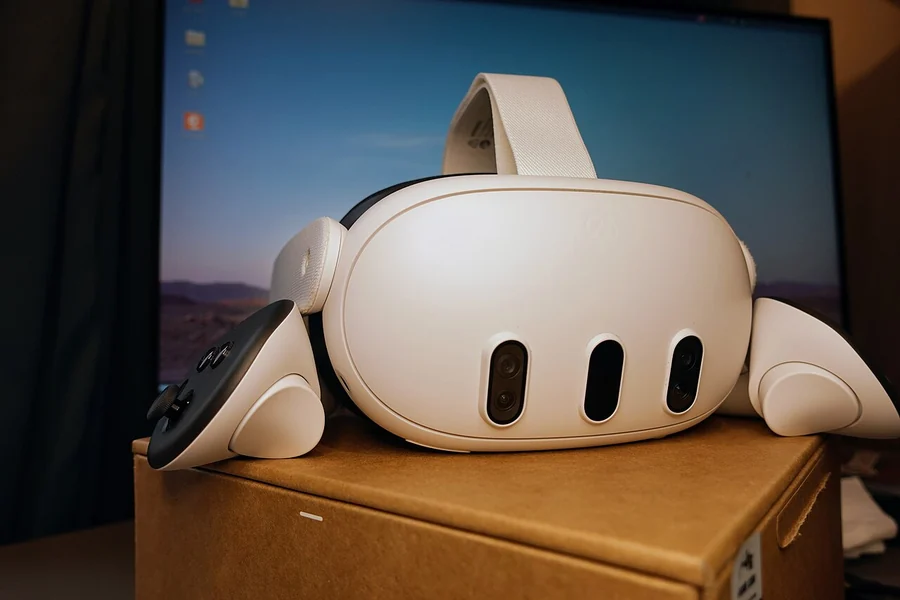
When Facebook (still under that name at the time, later renamed Meta) launched the Oculus Quest in 2019, it was a quiet revolution for the entire virtual reality industry. Until then, full-fledged VR meant either an expensive headset tethered by cable to a powerful PC (Oculus Rift, HTC Vive), or the more limited experience of the PlayStation VR console with base stations scattered around the room. The Quest was the first headset to break that rule: a standalone device with its own processor that needs no other computer or console to run, and requires no external cameras or sensors installed in the room.
The key to that freedom was so-called inside-out tracking — the headset has its own cameras mounted on its body, with which it scans the surrounding space and calculates its own position and the position of the controllers in real time. This does away with base stations screwed to the walls and the need to calibrate anything before each play session; the player simply puts on the headset, walks around the free space in the room, and is in. It was precisely this simplicity, combined with a reasonable price, that within a few years made the Quest the most widespread VR platform in the world and the main reason virtual reality turned from a lab experiment into an everyday consumer product in living rooms.
Under the hood, the headsets run a system derived from Android, adapted for VR needs, and the whole platform runs on chips with ARM architecture — the same lineage as mobile phones, not game consoles or PCs. This also defined the direction the Quest took: more an accessible, mobile experience for the general public than a photorealistic simulator for enthusiasts with the latest graphics card.
Tech: graphics and sound
The first Quest from 2019 was powered by the mobile Qualcomm Snapdragon 835 chip, silicon that until then had mainly appeared in phones. The display was a pair of OLED panels, which excelled in rich contrast and deep black, but as time went on and cheaper models emerged, Meta moved away from them. The Quest 2 from 2020 switched to the more powerful Snapdragon XR2 and, at the same time, to an LCD display — a move that at first glance looked like a step backward, but in fact allowed for higher resolution and lower manufacturing costs, which translated into a drastically lower price. It was precisely this combination that made the Quest 2 the best-selling VR headset in history.
Sound on the standard models is handled without headphones: speakers are built into the sides of the headset, playing spatial audio directly to the ears without shutting the player off from their surroundings; anyone who wants better isolation or privacy can plug in classic headphones via the jack. Performance-wise, the whole platform is limited to mobile chips, so the graphical fidelity of games never reaches PC VR levels, but for the seventy-plus frames per second that are a necessity in VR against motion sickness, it's more than enough.
Connectivity and peripherals
Standard equipment includes two motion controllers (Touch controllers), which the headset tracks with the same cameras it uses to scan the surrounding space — no external sensors, no cables. Newer generations can also track the player's bare hands without controllers at all, letting players gesture with their fingers in some apps. For players who want more than mobile performance offers, there's Quest Link mode: the headset connects to a powerful PC by cable, or wirelessly over home Wi-Fi (the Air Link variant), turning it into a full-fledged PC VR headset able to run graphically demanding titles that would never run on its own chip. The virtual boundary of the playable space, the so-called Guardian, the headset draws up itself based on what its cameras registered as floor and obstacles while looking around.
Models and revisions
The line kicked off with the Quest 1 (2019), with an OLED display and Snapdragon 835 chip. In 2020 came the Quest 2 — LCD display, the stronger Snapdragon XR2, and above all a significantly lower price, which made it the best-selling VR headset ever. Alongside the regular line came the expensive Quest Pro, aimed at professional use and expanded with eye and facial expression tracking. The turning point came in 2023 with the Quest 3: thinner pancake lenses instead of the older Fresnel ones, a more powerful chip, and color cameras on the front enabling color passthrough — the headset can now project a live view of the surroundings and place virtual objects into it, turning what was a purely VR device into a tool for so-called mixed reality as well. A year later came the cheaper Quest 3S, which combined the Quest 3's performance and passthrough cameras with the older, cheaper Fresnel lenses, so the platform would again have an affordable entry-level model.
Clones and variants
Direct clones in the style of retro consoles don't make sense for the Quest, since it's a current, software-locked platform — but the concept of a standalone, cable-free headset with inside-out tracking was quickly adopted by the competition too. The Chinese company Pico (owned by ByteDance) builds headsets with a very similar philosophy, HTC offers its own standalone lines derived from Vive, and even Sony, with the PlayStation VR2, reached for solutions that came close to the Quest in many ways, even though the headset remained dependent on the console. The closest thing to real competition in the premium standalone headset segment was the expensive Apple Vision Pro, though it targets productivity more than games.
Today's scene
Meta Quest remains an actively sold and supported platform, so unlike retro consoles, there's no need to resort to emulation — new units and games are readily available both in stores and digitally. The game library is sold through a store built directly into the headset, supplemented by App Lab for smaller and experimental titles that didn't make it into the main selection. Among players, the independent tool SideQuest has also taken root, through which apps can be sideloaded onto the headset outside Meta's store, including a range of free and community projects. Among the best-known titles are the rhythm action game Beat Saber, the action title Superhot VR, the survival horror Resident Evil 4 VR, the sprawling RPG Asgard's Wrath 2, or the relaxing Walkabout Mini Golf — a selection that nicely shows the breadth of the platform, from intense action to laid-back social play. Thanks to Quest Link and Air Link, owners can also connect the headset to their own PC and reach for the entire library of older and more demanding PC VR productions.
Games on this platform (56)

















Walkabout Mini Golf
Mini golf with finely tuned ball physics; themed courses hide their own secrets.












After the Fall
A cooperative zombie shooter for up to four players in a frozen, post-apocalyptic LA.



















No game in this genre.