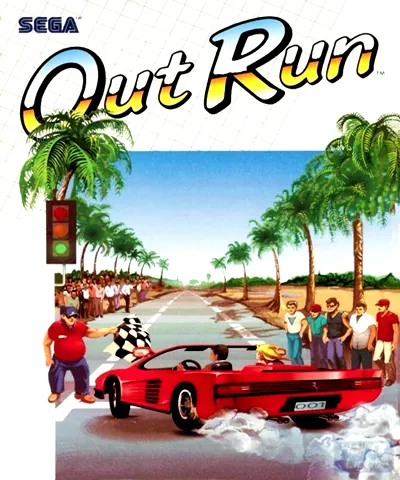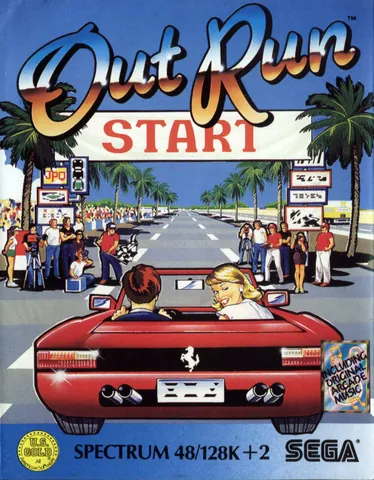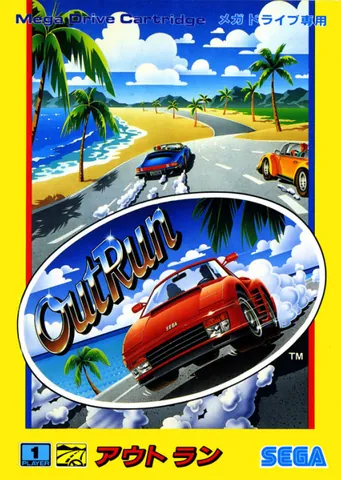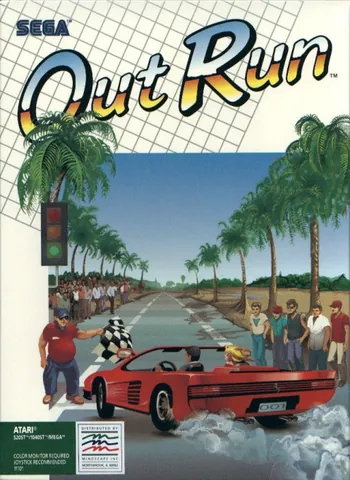
Get behind the wheel of a red convertible, seat a blonde beside you, and set off across an entire continent for the sheer joy of driving. Out Run is not a race for position or points in the classic sense — it is a celebration of speed, freedom, and the sunny atmosphere that defined one of the most famous arcade machines of the 1980s.
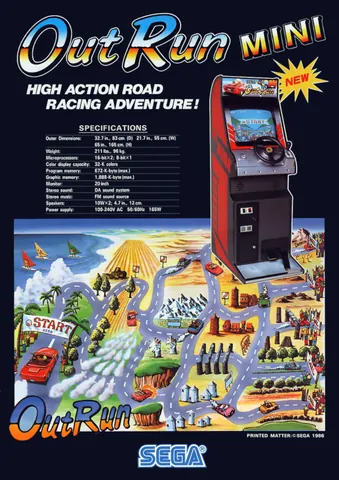
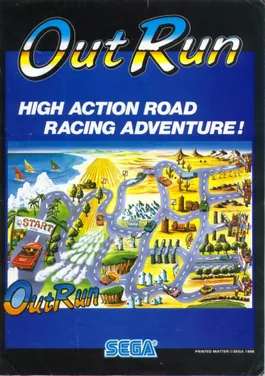
The Sega original from 1986, from Yu Suzuki's workshop, brought a revolutionary sense of driving, dynamic music selectable straight from the car radio, and above all a branching track where the player chose which way to continue at every junction. This gave rise to several different endings and enormous replayability. The arcade machine also became famous for its moving cabinet, which tilted into the turns.
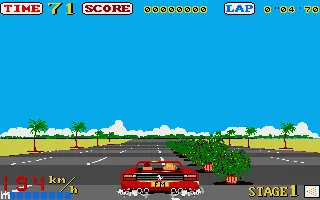
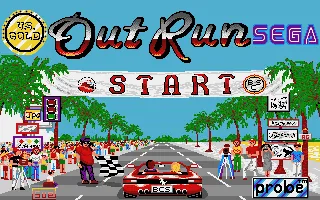
On the Atari ST, Out Run arrived as one of many home conversions that filled the catalogs of the era. Converting the arcade graphics and smoothness to a 16-bit computer was a challenge, and the port had to contend with the platform's limitations, but it strove to preserve the essentials: the feeling of the road rushing by, the branching tracks, and the characteristic laid-back mood.
Culturally, Out Run is a seminal game. It laid the foundations of the so-called arcade racer genre focused on the driving experience rather than simulation, influenced countless later titles, and its aesthetic and music became a symbol of an entire era. The brand continued with further installments and to this day is synonymous with summery, carefree driving.
Even on the Atari ST, Out Run retained its charm. It is a game you return to not for the challenge but for the feeling it leaves behind — that moment when the road opens up before you and you simply step on the gas.
Why play: For the timeless feeling of free driving and the branching tracks of one of the most influential arcade racing games of all time.
Game 17 of 72 for Atari ST
The same title elsewhere (9)
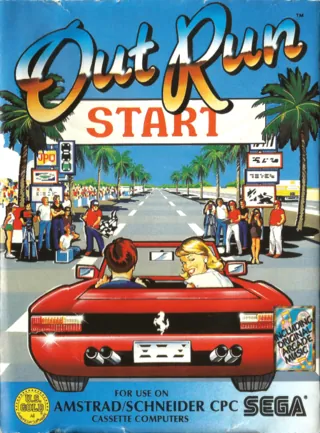
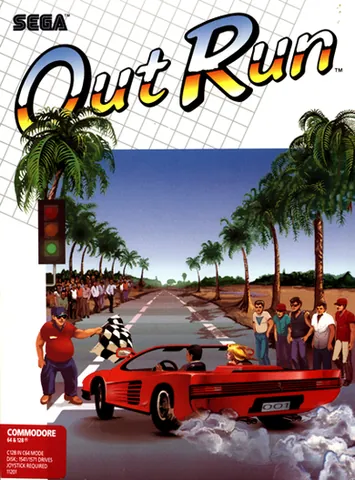
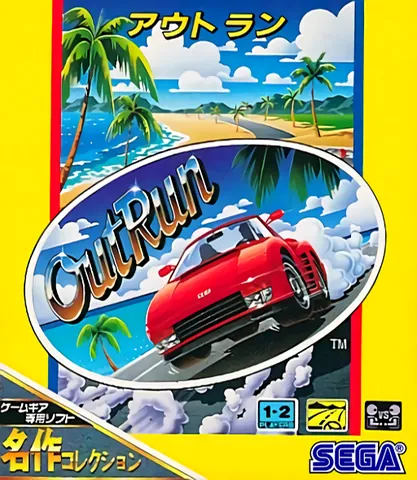
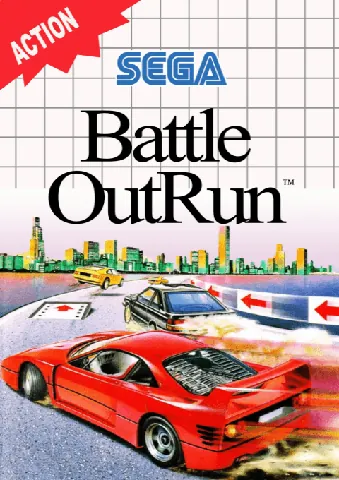
Sega's 1986 arcade original ran on special Super Scaler hardware that let the road scale smoothly into the distance, with three selectable tunes playing from the cabinet's speakers. Home computers could not fully recreate that illusion of speed: the Commodore 64, Amstrad CPC, and Atari ST versions all show noticeably choppier road scrolling and less track detail. The Amiga kept decent smoothness and nicer visuals despite the limitations, while the Master System surprised with fairly faithful graphics and music for an eight-bit console. For the real arcade feeling, the original remains unmatched.