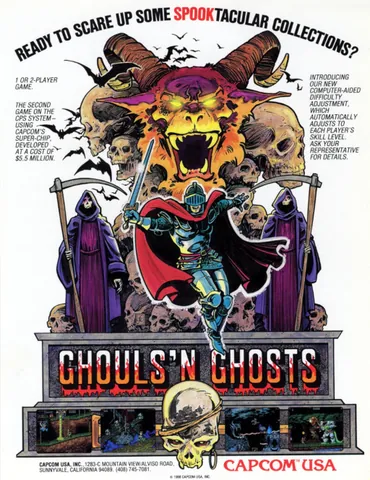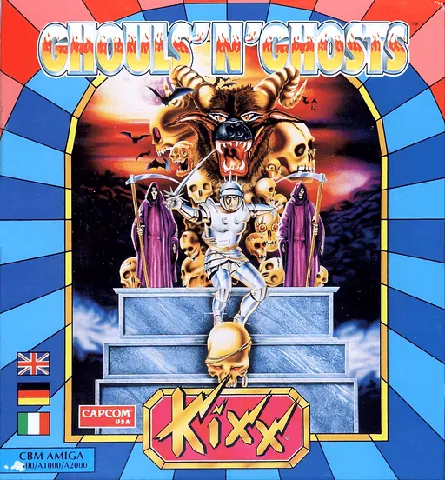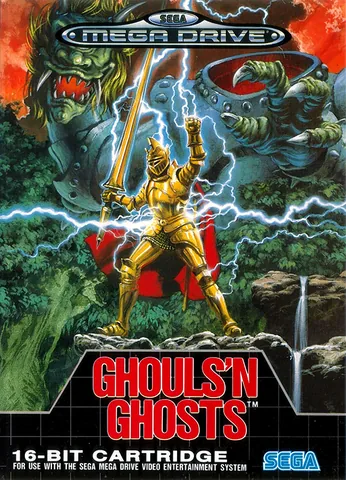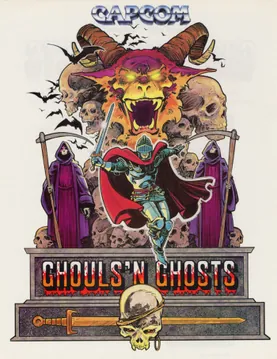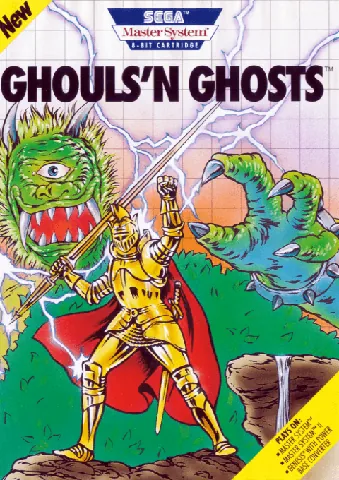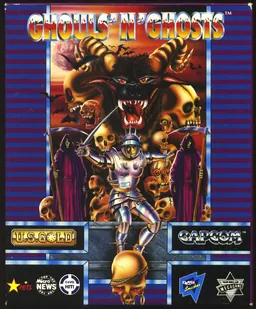
Knight Arthur dons his armor once again to save a kidnapped princess, and once again hell on earth awaits him — literally. Ghouls 'n Ghosts is the sequel to the notoriously demanding Ghosts 'n Goblins and ranks among the most challenging action platformers the arcades ever produced.
Capcom released the original on its arcades in 1988 and built on its predecessor's reputation as a game that punishes every mistake. Arthur can take only two hits — after the first he loses his armor and runs around in his underwear, after the second he crumbles into a skeleton. The game also introduced new mechanics, such as shooting up and down and a mighty golden armor capable of charging special attacks.
On the Atari ST, a port was created that ranked among the prized home conversions of Capcom arcades. Sixteen-bit computers were capable of conveying the colorful, gloomy atmosphere of graveyards, windmills, and castles full of the undead, even though converting the hellishly difficult gameplay was never easy. Nonetheless, the port retained the merciless challenge of the original.
The cultural significance of the series is enormous. Ghouls 'n Ghosts cemented the brand's reputation as a symbol of hardcore difficulty, influenced generations of designers, and to this day is referenced whenever the conversation turns to games that truly torment the player. The series continued with further installments including Super Ghouls 'n Ghosts and lives on in the modern era.
Anyone seeking an honest, old-fashioned, merciless challenge will find exactly that in Ghouls 'n Ghosts. It is a game that will kill you a hundred times over, and you will keep coming back for another try.
Why play: For the legendary difficulty and darkly fairy-tale atmosphere of one of the most demanding action platformers of the arcade era.
Game 18 of 72 for Atari ST
The same title elsewhere (5)
Capcom's 1988 arcade original ran on CPS hardware with sharp colors and merciless speed that home versions could only try to match. The closest conversion is the Sharp X68000 port, a Japanese computer built close to arcade hardware, so its graphics and pacing come nearest of all. The Mega Drive version ranks among the best home ports, though it had to trim some background detail. The Master System offered a simplified, shorter take with fewer colors. The Amiga and Atari ST struggled with slower scrolling and noticeably choppier animation compared to the arcade machine.