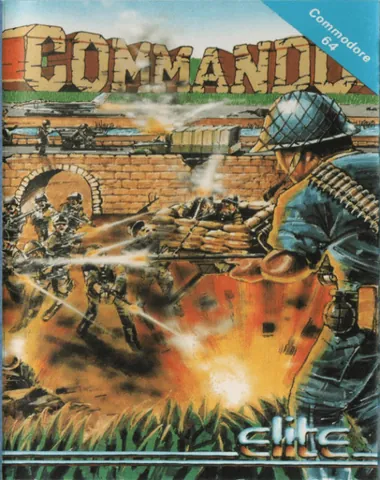
Commando
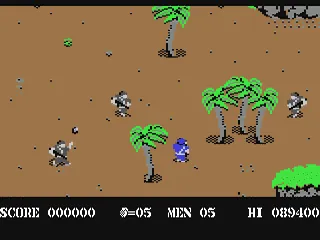
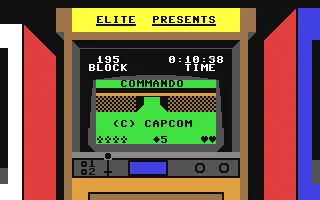
Few games managed to convey the atmosphere of the arcade as faithfully as Commando, one of the most-played action titles on the Commodore 64. This vertically scrolling run & gun shooter, in which you clear enemy territory as a lone soldier, defined an entire genre and became mandatory equipment on the eight-bit for anyone who loved proper action.
The premise is pure arcade essence: you advance up the screen, mow down hordes of enemy soldiers, throw grenades at fortified positions, and try to survive ever denser fire. The game does not slow down, does not forgive mistakes, and drives you forward at an uncompromising pace. It was precisely this immediacy and simplicity of control that made Commando an ideal title for short, intense gaming sessions.
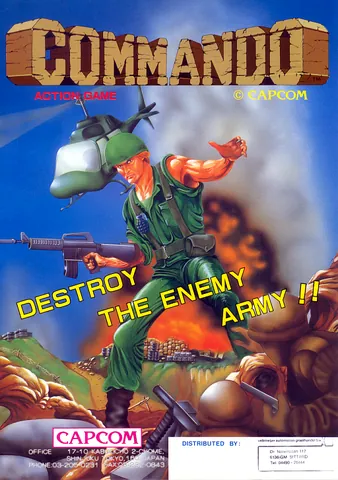
Originally it was an arcade machine whose home ports to the eight-bit platforms were provided by the publishers Elite and Imagine in the mid-1980s. Converting the hectic arcade action to the limited hardware of the Commodore 64 was not trivial, and yet it was pulled off so well that the C64 version was among the most popular. The game became part of the wave of arcade conversions that fed the home computer scene at the time.
Commando was among the most-played action titles on the Commodore 64 at all, and its influence is evident across the entire later wave of run & gun games. It became a benchmark of the genre, and its name still evokes memories of endless evenings spent clearing enemy positions. For many players it was their first experience with this type of action.
Culturally, Commando illustrates how crucial a role arcade machines played in shaping home gaming. Titles like this brought the arcade experience straight into the living room and helped define what we expect from action games to this day. It remains a textbook example of the run & gun genre in its purest form.
Why play: For uncompromising, addictive arcade action that defined the run & gun genre — one of the most-played action titles on the C64.
Game 22 of 121 for Commodore 64
The same title elsewhere (3)
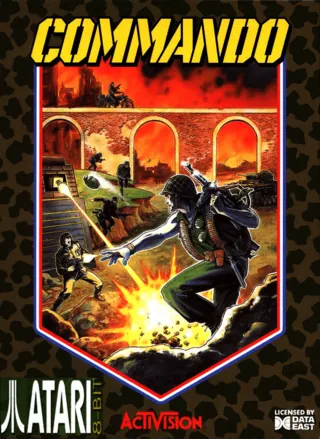
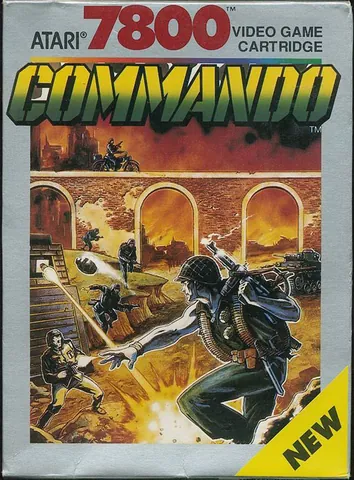
The arcade original benefited from the power of dedicated coin-op hardware — smooth vertical scrolling, plenty of enemies on screen at once, and crisp colours. The home 8-bit ports had to cut corners: on the Commodore 64 the SID chip at least gave decent music and sound, though the number of enemies and scrolling smoothness still fell short of the arcade. The Atari 800 offered a similar compromise with somewhat simpler graphics. The later Atari 7800 port could draw on the Maria graphics chip, which handled more moving sprites without flicker, making the action feel denser and closer to the arcade experience than the earlier 8-bit versions.