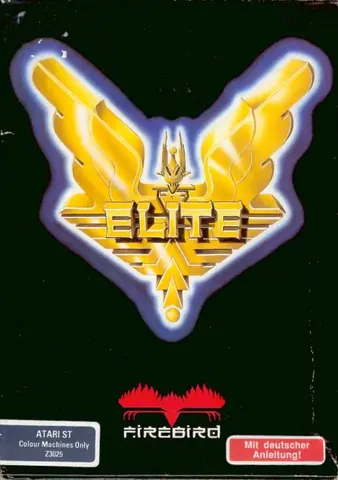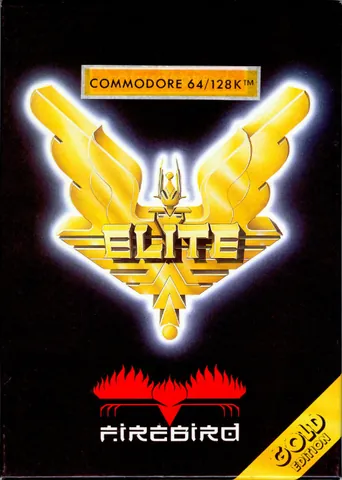
Elite
The black void of space opens up before you, a few credits on board and a single goal that you set for yourself. Elite is a visionary game that was decades ahead of its era — and on the Commodore 64 of 1985 it ranks among the most astonishing things the eight-bit ever managed.
Mechanically, it is an open space simulator: you pilot a trading ship, buy and sell goods between planets, mine raw materials from asteroids, avoid pirates or make a living from piracy yourself. No prescribed story, no linear path — you advance in rank from "dangerous beginner" to the coveted rank of Elite, but how you get there is entirely up to you. The wireframe cockpit graphics and the rotating space stations are among the iconic images of early games.
The greatest technical miracle is hidden under the hood. Authors David Braben and Ian Bell crammed entire galaxies into a few kilobytes of memory — a procedurally generated universe with eight galaxies and hundreds of planets, each with its own economic profile. Where others would have needed an impossible amount of data, they used mathematics that generated the worlds over and over according to the same formula.
The cultural significance of Elite is hard to overestimate. It is the forefather of the entire open-world genre, a predecessor of everything from the later space simulators to modern sandboxes where the player creates their own story. The idea of a game with no set goal, where freedom itself is the main attraction, was radical in the mid-eighties.
The C64 version brought this freedom to the wide audience of home computers and helped cement the game's status as a legend. Even after decades, Elite can draw you in with its sense of infinity and quiet adventure among the stars.
Why play: For the feeling that the universe belongs to you alone — no boundaries, just your ship, the economy, and the desire to reach the rank of Elite.
Game 25 of 121 for Commodore 64
The same title elsewhere (3)
This space legend originated on the BBC Micro with purely wireframe 3D ship graphics, and the home 8-bit ports handled that legacy differently. The Commodore 64 version gave ships filled, colored surfaces instead of plain outlines, making combat and docking look clearer and visually richer. The ZX Spectrum version stayed closer to the original wireframe style due to its more limited speed and memory, though the trading and combat systems are identical on both machines. Anyone wanting nicer, clearer 3D should pick the C64; fans of the stark wireframe look will prefer the Spectrum.