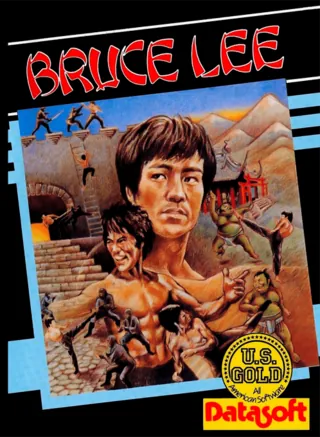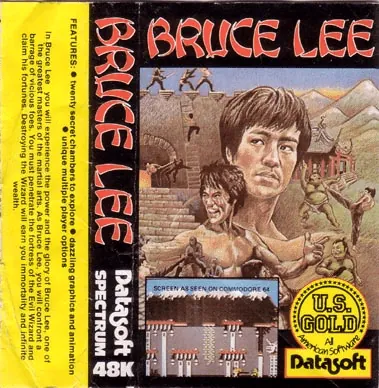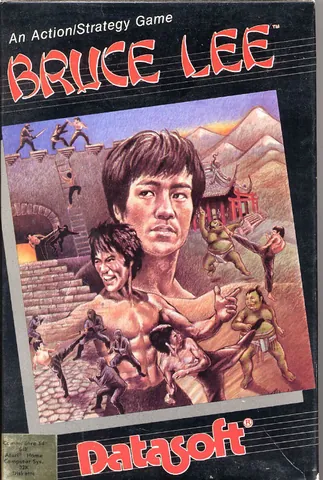
Bruce Lee
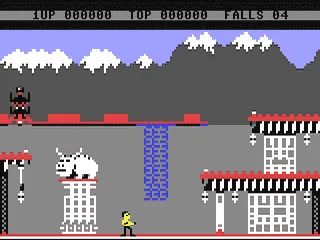
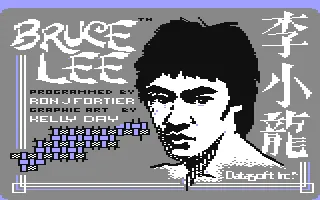
Few eight-bit games managed to create such an unforgettable experience with such simple means as Bruce Lee from 1984. This action platformer, built around the martial arts legend, became a cult classic on the Commodore 64 that old-timers still remember with nostalgia — and one that isn't hard to understand even after four decades.
The gameplay principle is elegantly straightforward: as Bruce Lee you fight your way through a series of connected rooms, collect lanterns suspended in space, and try to progress further while two enemies pursue you — the green Yamo with a stick and a black ninja with a knife. Fights are carried out with kicks and punches, the controls are brisk, and the whole experience has an addictive simplicity that keeps making you try again and again.
The game was developed by the Datasoft studio and released in 1984, at a time when home computers were still searching for their gaming language. Bruce Lee captivated players with its fluid controls and cleverly designed levels that combined action with a light element of finding one's way. An interesting feature is the two-player mode, where the second person could control one of the opponents, giving the fights an unexpected social dimension.
The title was released on a number of platforms of the time and found its fans on each of them — on the Commodore 64 it was just as cult as on the Atari, where it was among the most-played action games. Its simple but perfectly tuned gameplay made it one of the archetypes of the early action platformer, and the name Bruce Lee ensured it instant recognizability.
Culturally, Bruce Lee illustrates how strongly film and pop culture influenced early game creation and how little it took to create timeless entertainment. The game still stands as one of the symbols of the eight-bit era — proof that quality design does not age.
Why play: For timelessly addictive, simple action with a legendary name in the title — a classic that entertains even decades later.
Game 21 of 121 for Commodore 64
The same title elsewhere (2)
The Atari 800 was one of the lead platforms and offered smooth animation and solid colour that other versions were often measured against. The Commodore 64 benefited from its SID chip, giving the music and sound effects more depth and the colourful character sprites cleaner contrast. On the ZX Spectrum, though, the game was held back by the platform's classic weakness — attribute clash, where neighbouring objects on an 8x8 block can only share two colours, flattening the scene — plus a weak beeper that could only manage simple tones instead of music. Anyone chasing the experience closest to the original should pick the Atari or C64 version; the Spectrum port is really for fans of that era's home-computer scene.