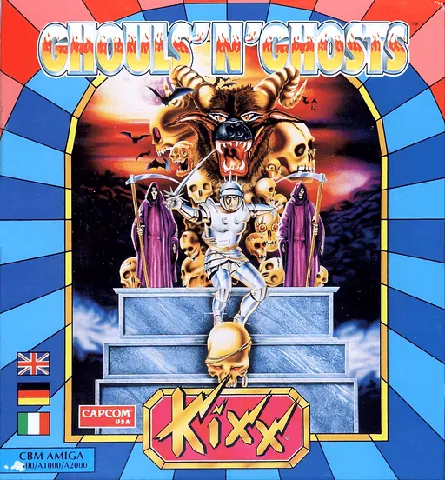
Ghouls 'n Ghosts
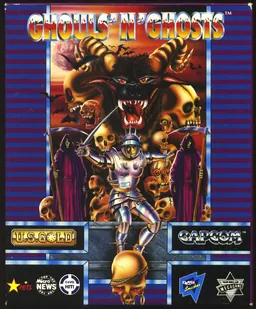
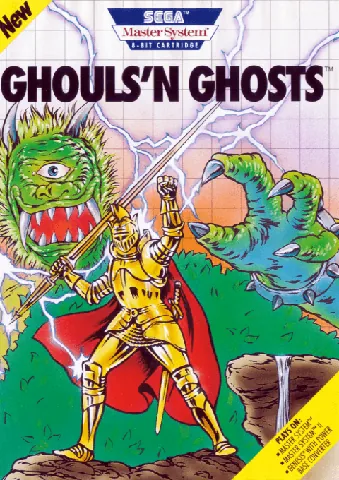
The knight Arthur stands in a graveyard wearing only his underwear, zombies whizzing around, and you already know one of the hardest journeys a platformer ever offered awaits you. Ghouls 'n Ghosts, ported to the Amiga from Capcom's 1988 arcade hit, is the sequel to the legendary Ghosts 'n Goblins, and it bears its reputation for merciless difficulty entirely deservedly.
The gameplay principle is brutally simple and all the more insidious for it. Arthur can take only two hits; the first strips him of his armor and leaves him running around in his boxers, the second turns him into a pile of bones. You advance from right to left and upward through hordes of demons, collect various weapons from spears to daggers and shields, and learn the enemy layout literally by heart, because improvisation here usually ends in death. The game is also famous for forcing you, after the first playthrough, to complete it again for the true ending.
The series' origins fall into the golden era of Capcom, when the studio churned out arcade cabinets with striking visuals and instantly recognizable design. Ghouls 'n Ghosts was designed by Tokuro Fujiwara, and the game became one of the symbols of the honest, uncompromising arcade school. The home conversion for the Amiga was prepared by the company U.S. Gold, and this version was among the above-average ports; reviews of the time praised both the graphics and the fidelity to the original.
Culturally, Ghouls 'n Ghosts became synonymous with a gaming challenge remembered with a mix of horror and respect. The figure of the knight Arthur in his boxers is an iconic image to this day, and the whole series later continued with titles like Super Ghouls 'n Ghosts on the SNES or Ultimate Ghosts 'n Goblins. For many players of the 80s and 90s it was a test of patience they never forgot.
Today the game remains a respected representative of an era when difficulty was not considered a flaw, but a part of the experience. Anyone who wants to reach the bottom of their nerves and at the same time appreciate honest retro design will find exactly that here.
Why play: For the legendary, uncompromising difficulty and iconic gothic platformer design from Capcom's workshop.
Game 57 of 121 for Commodore Amiga
The same title elsewhere (5)
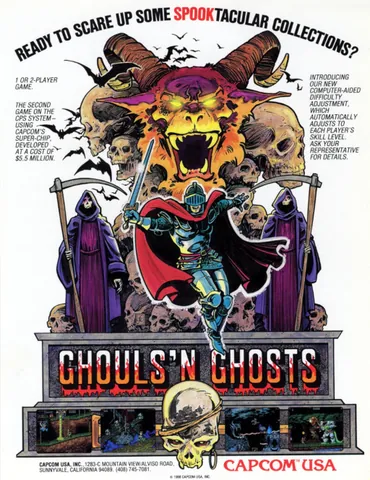
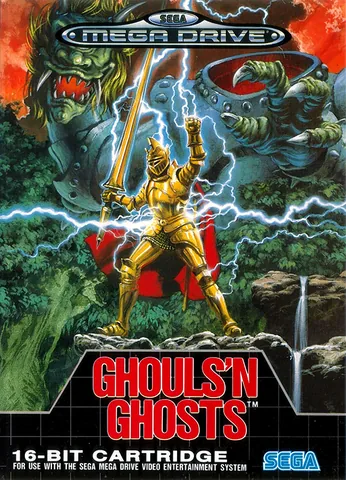
Capcom's 1988 arcade original ran on CPS hardware with sharp colors and merciless speed that home versions could only try to match. The closest conversion is the Sharp X68000 port, a Japanese computer built close to arcade hardware, so its graphics and pacing come nearest of all. The Mega Drive version ranks among the best home ports, though it had to trim some background detail. The Master System offered a simplified, shorter take with fewer colors. The Amiga and Atari ST struggled with slower scrolling and noticeably choppier animation compared to the arcade machine.