Golden Axe
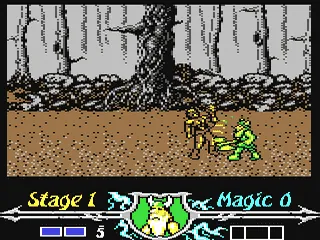
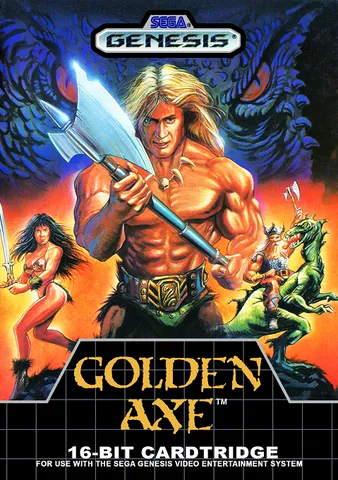
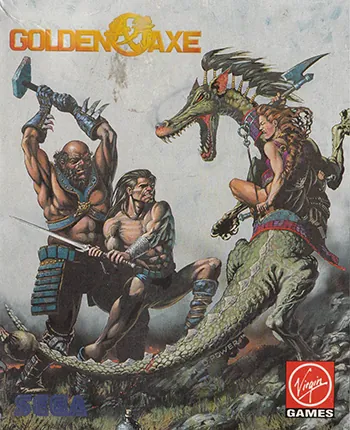
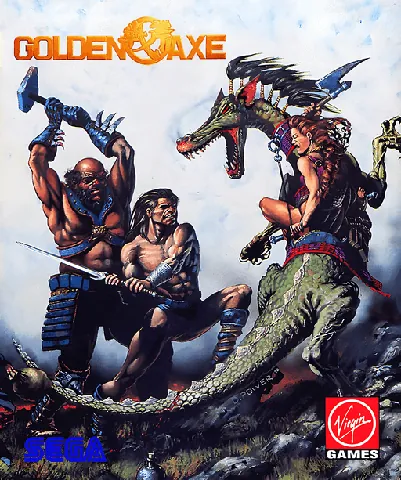
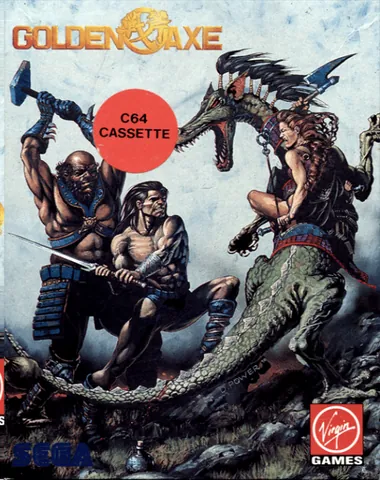
A barbarian with a raised axe, an amazon with a sword, and a dwarf overflowing with rage — Golden Axe on the Commodore 64 throws players into a fantasy world where every step is paid for with the blood of enemies. This home conversion of Sega's legendary arcade brawler tries to bring the raw power and magical atmosphere of the original into the memory of the beloved eight-bit machine, and it's precisely this ambition that makes it an interesting part of gaming history.
The game mechanics honor the canon of the beat 'em up genre. You advance through the landscape, pummel waves of the villain Death Adder's minions, and choose from a trio of heroes with different strengths. Alongside ordinary blows and weapons, magic plays a key role, which you fill up by collecting vials of essence from stolen sprites — the more essence, the more devastating the spell. An unforgettable ingredient is the mountable beasts, which you can jump onto and turn their jaws and tails against your enemies.
Behind the original stands the Japanese company Sega, which brought Golden Axe into arcades in 1989 on the System 16 board. The game immediately captivated with its gritty fantasy aesthetic and cooperative two-player play. Conversions for home computers including the Commodore 64 were made in Europe, and programmers had to cram the grand source material into hardware that was never built for such an onslaught of characters and animations at once.
Culturally, Golden Axe ranked among the pillars of the genre and became one of Sega's enduring brands. It inspired a number of sequels and ports, and alongside titles like Double Dragon and Final Fight it defined what a party of heroes fighting through hordes of enemies should look like. Its fantasy world remained in players' memories as one of the most atmospheric in the entire genre.
On the Commodore 64, Golden Axe is necessarily a more modest echo of the dazzling arcade original, but as a historical document it has its value. It recalls a time when every big gaming hit had to find its way onto all home platforms, and when programmers wrestled with technical limits to preserve at least the spirit of the original.
Why play: For a fantasy slaughter with magic and mountable beasts, and a look at how the eight-bit Commodore struggled with porting an arcade legend.
Game 46 of 121 for Commodore 64
The same title elsewhere (6)
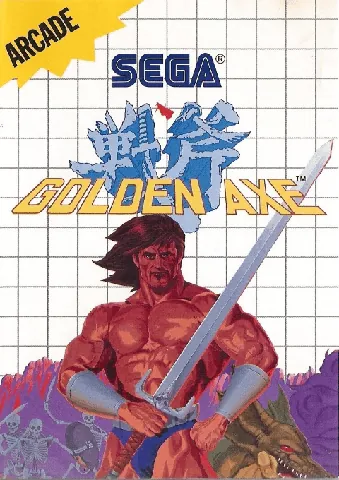
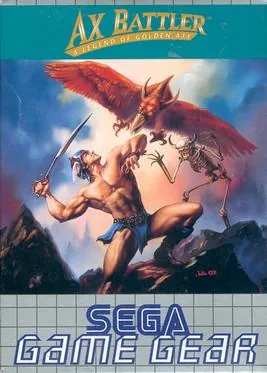
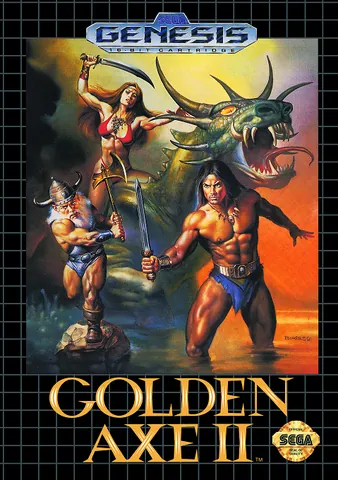
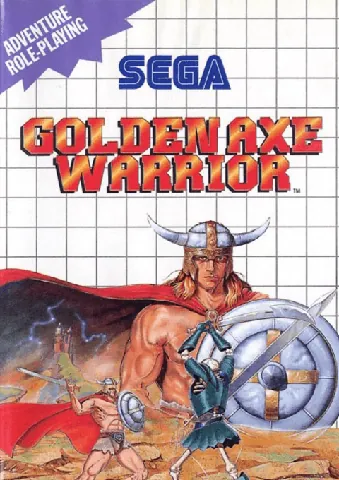
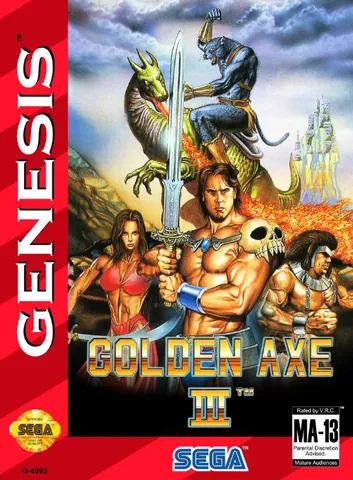
The 1989 Sega arcade original ran smoothly in bright, saturated colors and offered its full soundtrack alongside true simultaneous two-player action. The Mega Drive version came closest, keeping most of the atmosphere, music, and enemies, though some backgrounds and details had to be simplified. On the Master System, levels were shorter and the graphics plainer due to weaker hardware. Ports for eight- and sixteen-bit computers (Commodore 64, Amstrad CPC, Amiga, Atari ST) suffered from slower, choppier scrolling, a reduced color palette, and often lost simultaneous two-player co-op entirely. For the experience closest to the arcade cabinet, the Mega Drive version is the one to pick.