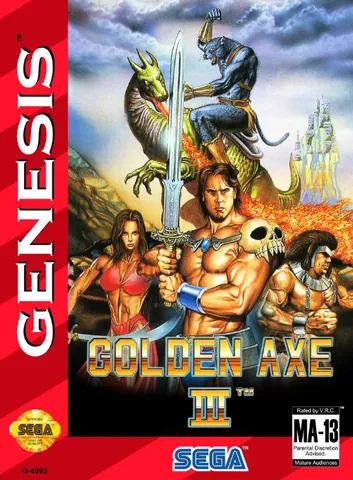
Golden Axe III
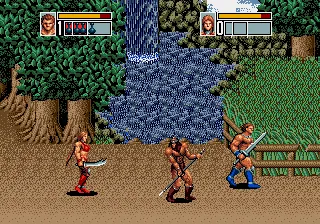
Golden Axe III is the third installment of Sega's fantasy beat 'em up, which, unlike the first two entries, never appeared in arcades but was created directly as a Mega Drive exclusive. Players once again take control of one of three warriors – this time newly chosen ones, with their own weapons and magical abilities – through a linear campaign full of battles against waves of enemies, rides on the backs of fantastical creatures, and boss fights at the end of stages. The core framework stays true to the series – sword slashing, magic attacks collected from little gnomes, and cooperative play for up to two players on one screen.
Compared to the previous entries, the third Golden Axe adds the option to choose between several character transformations during combat, which temporarily change their attacks, speed, and appearance, and also offers a branching level structure, where after finishing a stage the player can choose which path to take next, resulting in different playthrough variations and different final boss fights. Visually, the game makes full use of the Mega Drive's capabilities – colorful backgrounds, smooth animation of fighters and monsters, and a musical backdrop that carries on the atmosphere of the previous entries, albeit without the raw arcade punch that the first Golden Axe had in the arcade cabinets. The difficulty is somewhat gentler than in the first and second games, and the game relies more on variety than on tough repeated dying, which was appreciated by players who found the older entries frustrating.
Because the game never came out in North America and in Europe and Japan remained a Mega Drive exclusive without an arcade sibling version, it stayed less known than the first two installments for a long time. Among fans of the series, though, it's valued precisely for its branching structure, the transformation system, and new mechanics that never returned in any other Golden Axe title. Today it plays like an interesting detour: less iconic than the original Golden Axe, but in its own way more ambitious, and still fun for fans of 16-bit era beat 'em ups thanks to the variety it offers on repeated playthroughs.
Why play it: For fans of 16-bit era beat 'em ups looking for a lesser-known but more ambitious detour in the series – the branching structure and transformations offer fun even on repeated playthroughs.
Game 106 of 151 for SEGA Mega Drive