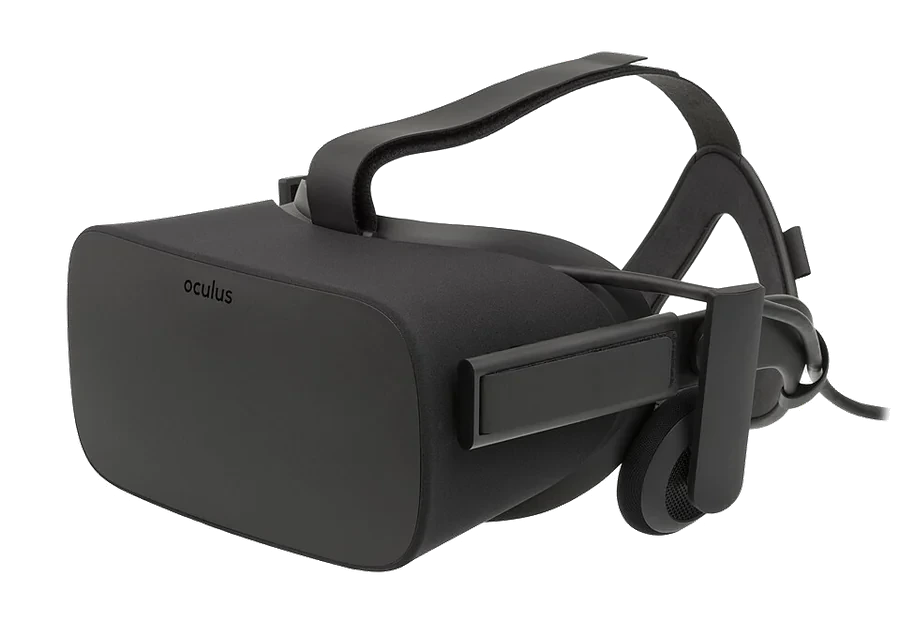
 Oculus / HTC / Valve · 2016
Virtual reality
PC VR (Rift, Vive, Index)
History & context
The year 2016 is the date around which the history of modern PC VR is usually told today. In February came the Oculus Rift CV1 — the first consumer version of the headset that began as a Kickstarter project and ended up under Facebook's wing — and in April it was followed by the HTC Vive, developed in collaboration with Valve. The difference between the two approaches was fundamental: while the Rift targeted playing seated or standing in place, the Vive brought room-scale tracking via external Lighthouse base stations, meaning the ability to walk around a room and have a 1:1 virtual space mapped onto the real one. Both kits also arrived with controllers for both hands, a shift in VR at the time comparable to the arrival of the analog stick on consoles.
So that games wouldn't have to run separately for each headset, Valve built the SteamVR software layer on top of the hardware, acting as a go-between for the game and the specific set of headset and controllers. Later it was joined by the open OpenXR standard, developed jointly by Valve, Microsoft, HTC, and other manufacturers — the goal was the same: write a game once and let it run on the Rift, Vive, Index, and other devices without the developer having to track the differences between individual SDKs.
The symbolic peak of this era is Half-Life: Alyx (2020). Until then, a VR game had been either a short technology demo or an arena for a few minutes of fun — instead, Valve released a title with the budget, length, and craftsmanship of its major serial games, just controlled by hand in virtual space. PC VR today is also played through headsets that originated elsewhere: the Meta Quest can be connected to a computer by cable or wirelessly and behave like a full PC kit. Around the platform there's also a strong modding scene — a number of successful flat-screen games, from Skyrim to racing simulators, have unofficial VR mods that can switch classic controls over to a headset and motion controllers.
Technology: graphics and sound
VR places different demands on graphics than an ordinary game on a monitor — the image is computed twice, once for each eye, and it has to be done at a high frame rate, because dropping below a certain threshold causes nausea in many people. The Rift CV1 and Vive both started at 90 Hz; the Valve Index (2019) went further and offered up to 144 Hz at a reduced field of view, or 120 Hz at the full one. Display resolution gradually grew from roughly 1080×1200 pixels per eye on the first kits to higher panels on later revisions such as the Vive Pro. Lenses evolved from classic Fresnel designs to thinner pancake constructions, which allowed for smaller, lighter headsets. Sound is handled by spatial audio, which by simulating how sound reaches the ears from different directions reinforces the feeling that the player is really present in the virtual space — on some models via headphones built directly into the headband, on others via the player's own headphones plugged in.
Connectivity and peripherals
Two competing principles handled tracking of head and hand position. Vive and Index used outside-in tracking: Lighthouse base stations placed around the room emit invisible infrared beams that sensors on the headset and controllers pick up, from which precise position is calculated. The newer Rift S (2019), by contrast, switched to inside-out tracking via cameras built directly into the headset, with no need to install anything around the room — the same principle later inherited by the standalone Quest headsets. Controllers evolved from simple "wands" on the Vive through Oculus Touch to the Valve Index Controllers, nicknamed Knuckles, which thanks to capacitive sensors can track the movement of individual fingers, letting a player naturally open their hand or point a finger in virtual space. The physical connection to the computer went through a combination of cables for video and data, on some kits simplified into a single detachable cable; wireless add-ons also existed that replaced this cable with a battery-powered transmitter.
Models and revisions
Oculus had a pair of developer kits, DK1 and DK2, even before the CV1, which let early enthusiasts and studios try VR before the commercial launch. After the CV1 in 2016 came the Oculus Rift S in 2019 — lower price, higher resolution, but above all a switch to inside-out tracking without external sensors. It was also the last Rift generation aimed purely at PC: Meta went on to focus on the standalone Quest line. HTC gradually expanded its Vive with the Vive Pro (2018), offering higher resolution and built-in front cameras, later the Vive Pro 2 and Vive Cosmos with their own inside-out tracking. The Valve Index from 2019 remains the only generation of the Index brand so far — Valve keeps selling the headset practically unchanged and focuses mainly on the software side via SteamVR.
Clones and variants
Beyond this trio, its own platform emerged too — Windows Mixed Reality, built by Microsoft, under whose banner headsets were offered by companies like Samsung (Odyssey), HP (Reverb), Acer, and Lenovo — all with inside-out tracking and no need for base stations. Microsoft wound down support for WMR over the years. At the opposite end of the spectrum stood the crowdfunded Pimax, with series like the 5K and 8K, aimed at an extremely wide field of view for enthusiasts willing to accept higher demands on both performance and price. A special chapter belongs to the Revive tool, which the community created so that games locked to the Oculus Store could also be run on the Vive or Index via SteamVR.
The scene today
The center of gravity of the headset market has shifted since the days of the CV1 and Vive — today far more standalone Quest kits are sold than classic PC headsets, and even those typically connect to a computer via cable or wireless Air Link rather than as standalone PC devices. SteamVR and the Valve Index nevertheless remain home to the enthusiast side of the scene: flight and racing simulators, social spaces like VRChat, or rhythm games in the vein of Beat Saber all have a loyal audience here that builds its PC specifically around VR. The Rift CV1, Vive, and Index today are mostly found secondhand for a fraction of their original price and still work with current games on Steam, making it the cheapest way to experience the birth of modern PC VR on the original hardware.
Games on this platform (29)


























No game in this genre.