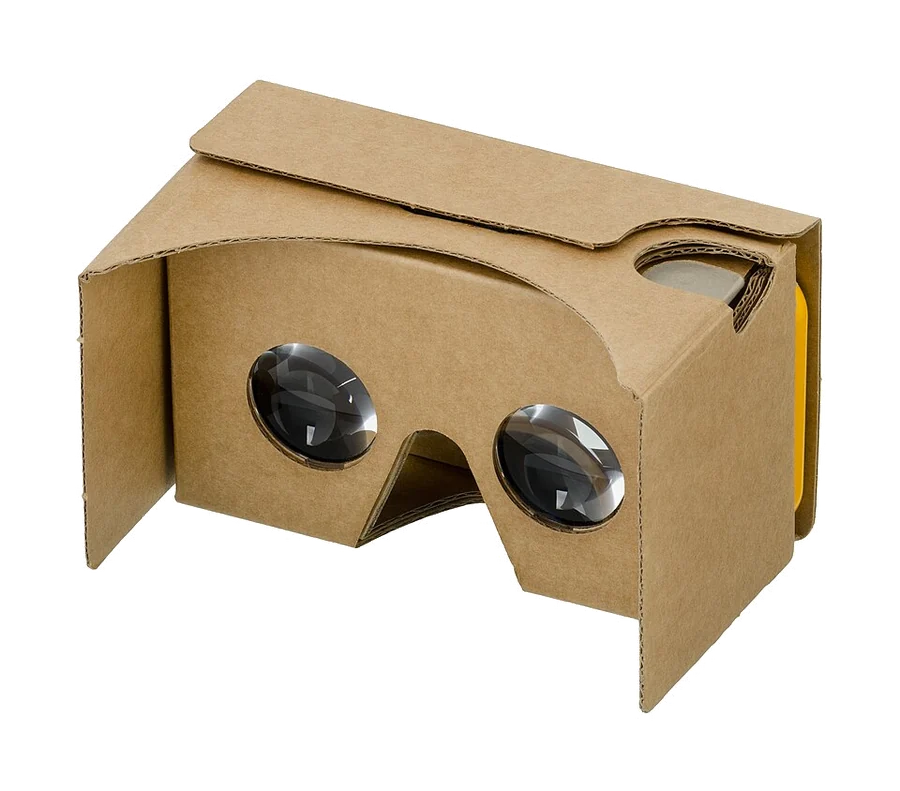
 Google · 2014
Virtual reality
Google Cardboard
History & context
Google Cardboard is the cheapest and most widespread gateway into virtual reality imaginable — a piece of pressed cardboard, two lenses, and a rubber band. Google unveiled it in 2014 at the Google I/O conference as an almost tongue-in-cheek experiment: what if the world's cheapest VR headset was just an ordinary box you slot your own phone into? The display, processor, gyroscope, and accelerometer are already sitting ready in your pocket — all you need to do is point them at your eyes correctly.
The box itself contains no electronics at all. It's assembled from cardboard according to a simple plan, with two plastic lenses added, a magnet or later a touch lever on the side, and a strip of Velcro or a rubber band to hold it all against your face. The instructions were freely available from the start, so anyone with scissors and a bit of patience could build a Cardboard at home, and companies could have their own branded versions manufactured as a cheap promotional item. Google itself gave away boxes as a newspaper insert, among other things in partnership with The New York Times.
That cheap accessibility was the whole point of the project. Cardboard was never meant to compete with powerful headsets like the Oculus Rift — it was about democratization, about getting the feeling of virtual reality to millions of people who would otherwise never buy or even try an expensive headset. The games and experiences were necessarily short and simple, more technology demos than fully fledged titles, but the effect of "I had VR on my head for the first time in my life" landed for a huge number of people precisely thanks to Cardboard.
Technology: graphics and sound
Cardboard has no display or processing power of its own — both are supplied by the inserted smartphone. The image on the phone's display is split into two halves, each projected through one lens into one eye, creating a stereoscopic 3D impression and a sense of depth. Image quality was therefore directly derived from whichever phone the user happened to slot in — from the sharp displays of flagship models to the grainier picture of cheaper handsets. Frame rate and smoothness depended on the phone's performance, so more demanding applications on weaker hardware would occasionally stutter, which feels far more unpleasant in VR than in an ordinary game.
Head tracking was handled by the gyroscope and accelerometer built into the phone — Cardboard needed no external sensors or cameras of its own. Sound played either through the phone's speaker or through headphones plugged into the phone itself; the headset had no audio hardware of its own. The lenses had a fixed focal length, and on some models the distance between them could be slightly adjusted to fit a wider range of users.
Connectivity and peripherals
Controls were minimalist by design. The first version had a single button — a small magnet glued to the side of the box, which the user dragged across the surface, and the phone's magnetometer would detect its movement as a click. It was clever and cheap, but an unreliable solution, since not every phone reacted with the same precision. The second generation (2015) replaced the magnet with a simple mechanical lever that physically tapped the touchscreen through a conductive pad — more reliable, but still just a single button.
For developers, Google released an SDK for Android and iOS, which made it possible to build applications specifically for Cardboard and offer them on Google Play and the App Store. A so-called Cardboard app also emerged, acting as a hub — a QR code on the box told it the lens dimensions and the specific model so the image could be calibrated correctly. Besides games, Cardboard was mainly used for 360-degree videos and virtual tours, including the school project Google Expeditions.
Models and revisions
The first generation of Cardboard from 2014 was a purely cardboard box with a magnetic controller, folded into a shape that resembled a camera with a neck strap. The second generation from 2015, unveiled at Google I/O alongside the announcement of the Daydream platform, brought a more universal design that worked with larger phones, a redesigned lever instead of a magnet, and easier assembly. Both versions existed both as an official paid product in the Google Store and as a freely published technical diagram for home construction.
Google formally ended the project in 2021, announcing that it would no longer actively develop the Cardboard app, and as a parting gesture released the complete SDK as open source. Developers could thus keep apps built on Cardboard running even without Google's support, and the technology remained usable even after official support ended.
Clones and variants
The low barrier to entry naturally sparked a wave of imitators and improvements. The best known was the Samsung Gear VR, developed in collaboration with Oculus — a plastic headset with its own optics and a control touchpad that offered a substantially more comfortable experience, but only worked with select Samsung phones. Homido or the Zeiss VR One went down a similar path — mid-range plastic headsets that took the same "phone as display" principle and packaged it into a more durable, more comfortable shell with a head strap.
A cheaper, direct answer to Cardboard was the Mattel View-Master VR, which borrowed the name and shape of the legendary stereoscopic toy from the mid-20th century and applied it to smartphones — no extra electronics, just a sturdier and more compact body than cardboard. At the other end of the spectrum stood the phone-powered Google Daydream View, which offered even a standalone controller with a gyroscope, considerably more than Cardboard's single button.
The scene today
Cardboard today isn't a platform you can "play" in the traditional sense — it's more of a museum piece from the early era of mobile VR. Emulation or Batocera make no sense here, since it was never hardware with a processor, but an optical box dependent on the phones of the time and on apps that are no longer updated. Meanwhile, many older Cardboard apps and games have vanished from Google Play or stopped working with newer versions of Android, so trying the original experience gets harder by the year.
Anyone wanting to recapture the Cardboard feeling today has the easiest path through the open SDK and newer web-based WebXR demos, which run directly in a mobile browser without needing to install anything, or by tracking down archived APKs legally offered by developers. Physical boxes can still be found as cheap replicas or built from freely available templates. As a gaming platform it was more a flash in the pan than a lasting scene, but as a milestone that put VR in the hands of millions of people for the first time in history, Cardboard holds a place that no more powerful headset can take from it.
Games on this platform (12)

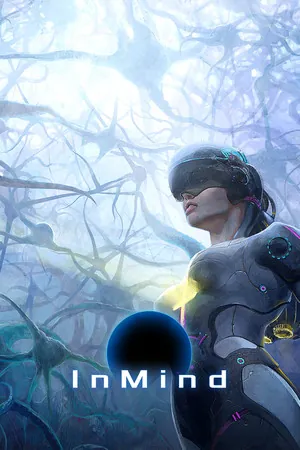
InMind VR
A flight through the brain and nerves, where head gaze is used to target damaged synapses.


No game in this genre.