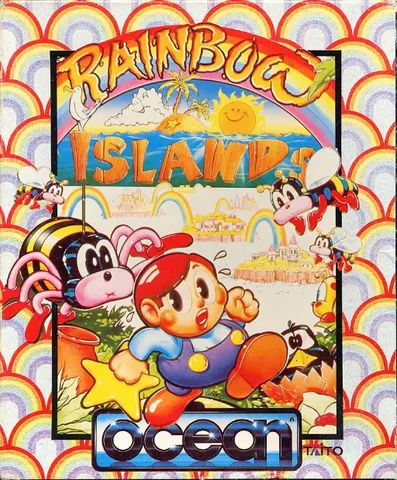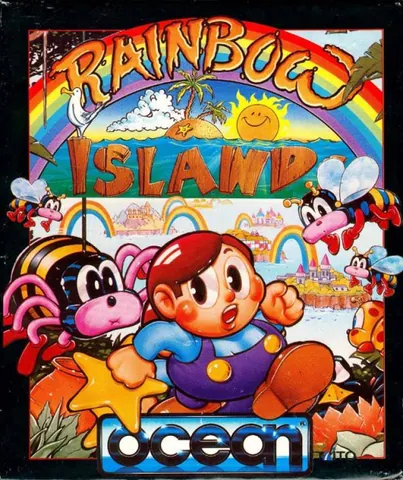
Rainbow Islands
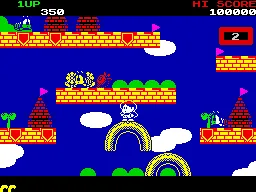
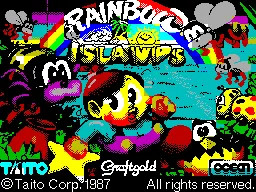
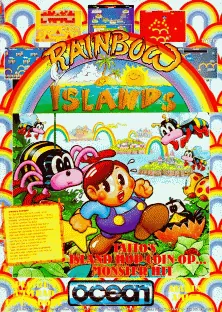
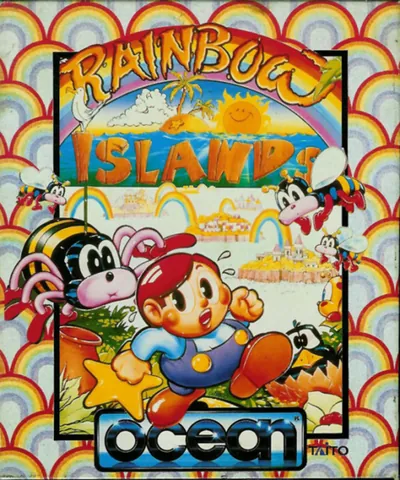
Sometimes the greatest proof of a game's quality is how well it survives the move to weaker hardware - and Rainbow Islands on the ZX Spectrum is exactly such a case. A colorful, playful arcade platformer that proved great conversions could be made even on the modest British 8-bit.
The core of the gameplay is enchanting: you climb upward through vertically structured levels, creating rainbows that serve both as stairs to higher floors and as a weapon against enemies. You can drop a rainbow onto the enemies below you, climb higher along it, or forge a path upward while a rising water level around you forces you to keep climbing. It is a simple idea, yet surprisingly rich in tactics.
The Spectrum version is among the excellent ports of arcade and multiplatform classics that showed what experienced programmers could wring out of limited hardware. Where other conversions failed on colorful graphics or smoothness, Rainbow Islands managed to preserve its joyful spirit even though the Spectrum was never a machine built for colorful arcade orgies.
The game's charm lies in the contrast between its cute, fairy-tale look and its surprisingly deep mechanics. Beneath the friendly surface hides a layer of item collecting, bonuses and hidden secrets that rewards players for experimentation and speed. The chase for the best possible run quickly becomes addictive.
In the context of the Spectrum, Rainbow Islands is proof that the platform was not doomed only to single-color compromises - with the right approach it could host colorful, dynamic platformers too. For fans of arcade conversions it is one of the titles remembered with respect.
Why play: For a joyful, rainbow-laced platformer that managed to carry the magic of the arcade onto the modest Spectrum - a sweet look, a surprisingly deep game.
Game 7 of 100 for ZX Spectrum
The same title elsewhere (6)
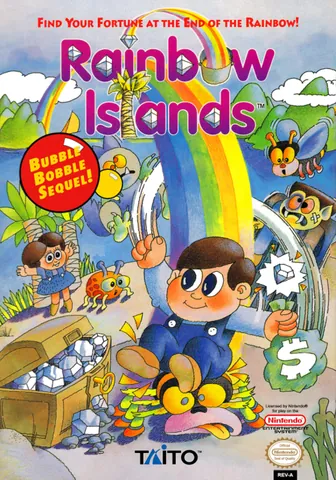
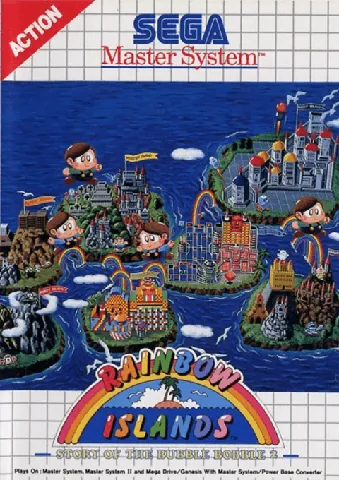
Rainbow Islands, the sequel to Bubble Bobble, differed across platforms mainly in how much colorful variety and smooth rainbow-climbing each system's hardware could handle. Taito's arcade machine remains the reference experience, with the richest color palette and smoothest movement. Amiga and Atari ST came closest to it, preserving both color and music. The 8-bit computers Commodore 64, ZX Spectrum, and Amstrad CPC had to limit on-screen colors and simplify backgrounds to keep scrolling playable, yet thanks to great music they earned their own loyal fans. The NES version was a direct rework by Taito with its own graphical style suited to the Nintendo console. SEGA Master System got a colorful conversion considered one of the nicer-looking ones among 8-bit consoles.