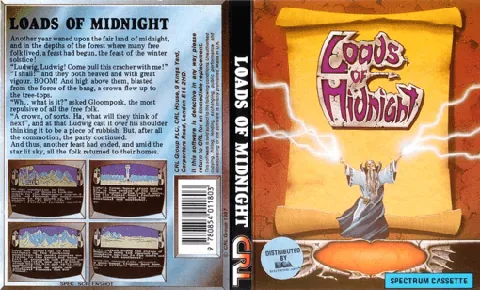
Lords of Midnight
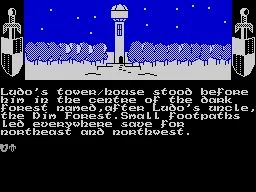
Imagine being able to stand atop a snow-covered hill, gaze out across an entire landscape of mountains, forests and distant towers - and all of this on the eight-bit ZX Spectrum in 1984. That is exactly the feeling offered by Lords of Midnight, the ambitious work of Mike Singleton, which to this day ranks among the boldest titles of its era.
The key to this illusion was a technique Singleton called landscaping: you do not see the world from above as on a map, but from the perspective of individual characters. You turn to the eight compass directions and the landscape redraws itself before you - the mountains you spotted on the horizon gradually draw nearer as you journey onward. On a few dozen kilobytes of memory, a sprawling fantasy world of thousands of locations came into being, one that felt far larger than anyone would have expected.
The story breathes with a Tolkienesque epic. The dark lord Doomdark marches with his hordes on free Midnight and you command heroes led by Luxor the Moonprince. What is truly brilliant is that the game offers two entirely different paths to victory. Either you gather your armies, face the enemy in an open strategic battle and crush Doomdark by force - or you set out on an adventure quest with Morkin, who must slip into enemy territory and destroy the source of the malevolent power, the Ice Crown. You can even pursue both threads at once, juggling war and a secret expedition.
Each character has their own morale, attributes and the ability to recruit further commanders and troops, turning it into a game that is half turn-based strategy, half sweeping novelistic saga. The atmosphere was heightened by textual descriptions in the style of heroic fantasy, which gave the dry game data a soul and a narrative charge.
Mike Singleton returned to this world with the sequel Doomdark's Revenge, and the series was later revived through fan remakes and versions for newer platforms, which only confirms how strong a cult grew around the game. Lords of Midnight is regularly cited among the most important titles in ZX Spectrum history and repeatedly appears high in British retro polls.
Why play it: For a visionary glimpse of how, as early as 1984, a huge, explorable fantasy world could be conjured up - and for the rare freedom to choose between the sword and a silent expedition.
Game 11 of 100 for ZX Spectrum