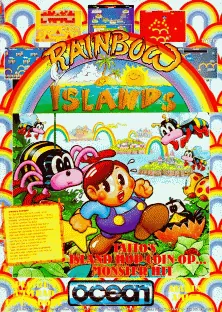
Rainbow Islands
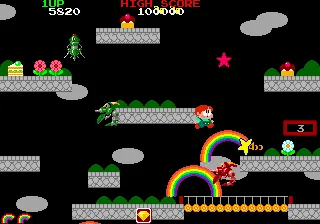
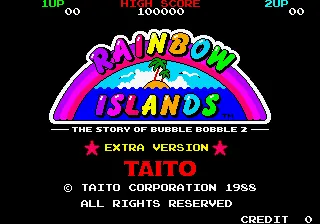
A rainbow as a weapon. That's the image from Rainbow Islands that stays in your head forever. Instead of firing at enemies, you conjure a shining arc above you that serves at once as an attack, a staircase and a shield. This single mechanic turns an otherwise simple platforming climb into a little puzzle box full of ideas.
It's a spiritual successor to the legendary Bubble Bobble, and you can tell at once. The same adorable graphics, the same catchy music, the same devilish depth beneath the sugary shell. The goal of each island is to climb the rainbows to the top before the rising water level catches up with you. That turns the peaceful jumping into a nervous race against time, where every wrong arc can mean the end.
The beauty of the game lies in its layers. On the surface it's a colourful platformer for kids. Beneath the surface lurks an elaborate system of collecting gems in a specific order, secret items and above all hidden conditions for reaching the true ending. Players who wanted to see the real finale had to grasp mechanics that an ordinary passer-by had no idea existed.
Working with the rainbows offers surprisingly deep tactical options. You can let an arc drop onto enemies, jump onto it and then smash it out from under yourself, or use it to build a path across a chasm. Experienced players chain these actions into fluid sequences that look like a dance. It's precisely this elegance of movement that makes Rainbow Islands a title people return to for decades.
In its day the game charmed with its aesthetic and inventiveness, and to this day it ranks among the most beloved arcade platformers ever. It's a rare case where a game is at once perfectly accessible to a complete beginner and yet hides so many secrets that experts have been dissecting it for years.
Why play: For the irresistible magic of one brilliant mechanic that is an attack, a bridge and a rescue all at once, and for a platformer that is sweet on the surface and devilishly deep within.
Game 2 of 258 for Arcade
The same title elsewhere (6)
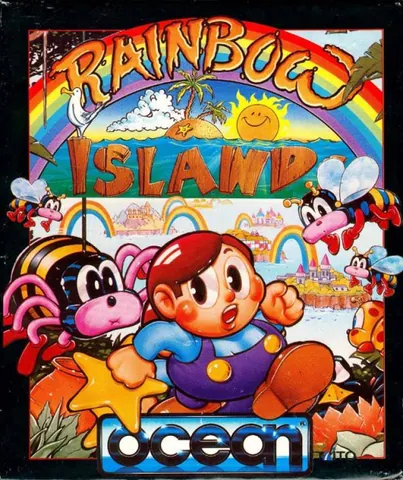
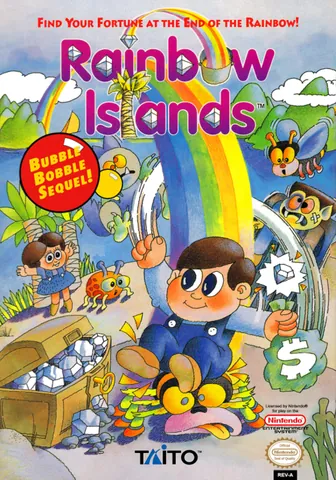
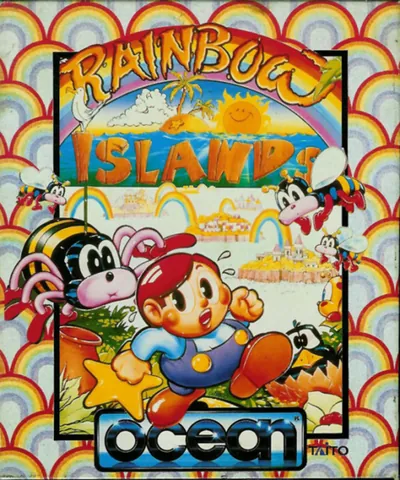
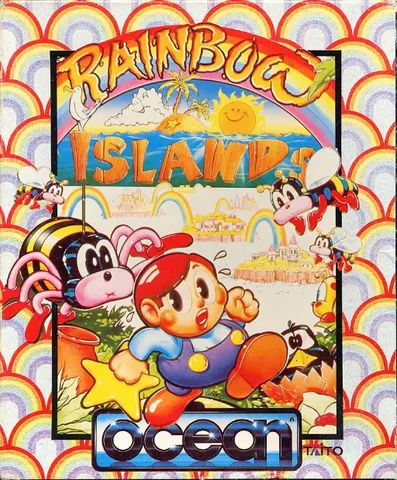
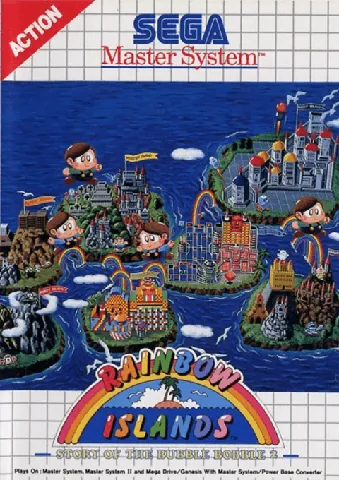
Rainbow Islands, the sequel to Bubble Bobble, differed across platforms mainly in how much colorful variety and smooth rainbow-climbing each system's hardware could handle. Taito's arcade machine remains the reference experience, with the richest color palette and smoothest movement. Amiga and Atari ST came closest to it, preserving both color and music. The 8-bit computers Commodore 64, ZX Spectrum, and Amstrad CPC had to limit on-screen colors and simplify backgrounds to keep scrolling playable, yet thanks to great music they earned their own loyal fans. The NES version was a direct rework by Taito with its own graphical style suited to the Nintendo console. SEGA Master System got a colorful conversion considered one of the nicer-looking ones among 8-bit consoles.