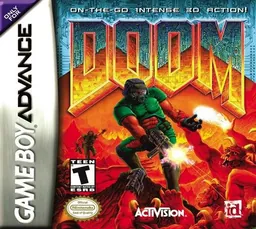
DOOM
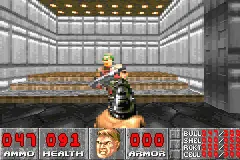
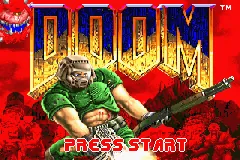
DOOM is a port of the legendary 1993 FPS that brought the principles of shooting through pseudo-3D corridors to the Game Boy Advance on hardware without any 3D accelerator whatsoever. The player once again fights through Martian bases and hellish dimensions full of demons, collecting weapons ranging from the pistol through the shotgun to the plasma rifle, and searching for keycards that open the way forward. The controls were completely reworked for a handheld with no mouse – aiming and movement are handled by the d-pad and buttons, which costs some of the fluidity, but the core concept remains recognizable at first glance, and the basic gameplay loop of advancing, shooting, and hunting for keys stayed intact.
Technically, it's a remarkable achievement: the raycasting engine, which demanded decent performance on PC, was scaled down and adapted to run on a battery-powered handheld, albeit at the cost of lower resolution, simplified textures, and a limited number of enemies on screen at once. The levels draw on the original episodes, and thanks to the sound design and oppressive pacing, the atmosphere of the dark bases and hellish levels holds up fairly well even in this reduced form. For its release year, it was a clear demonstration of just how far id Software's engines could be pushed in terms of portability, and at the time many players simply didn't believe something like this could run on the GBA at all.
Contemporary reactions were mixed – critics praised the technical daring and faithfulness to the core concept, but also pointed out the limited controls and the visible cuts compared to the PC version. From today's perspective, GBA DOOM is interesting more as a historical curiosity and proof of the developers' technical skill than as the ideal way to experience the game for the first time. For fans of the series and port collectors, though, it remains a fascinating piece of gaming history on handheld hardware, and a reminder of an era when engines got ported to machines they were never designed for.
Game 127 of 170 for Game Boy Advance
The same title elsewhere (1)
The PC/DOS version is the original and remains the definitive edition — it ran at higher resolution, supported mouse-and-keyboard controls, and had music through sound cards like the Sound Blaster or AdLib. The Atari Jaguar port became famous for a different reason: under time pressure the developers cut the music entirely, so you play through in near silence with only sound effects, even though the speed and smoothness of the action were praised at the time as remarkably good for a console. The SEGA 32X version came off worst of all — its levels had to be shortened and rearranged compared to the original, resolution and frame rate were lower, and its thin music plus sluggish pace still make it the weakest and least recommended way to play Doom.
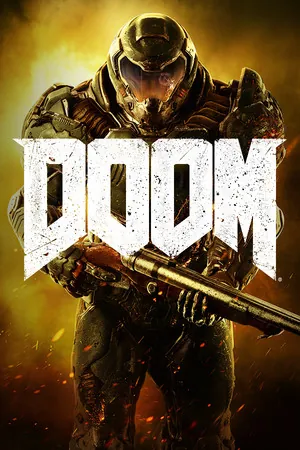
From the same series Doom →
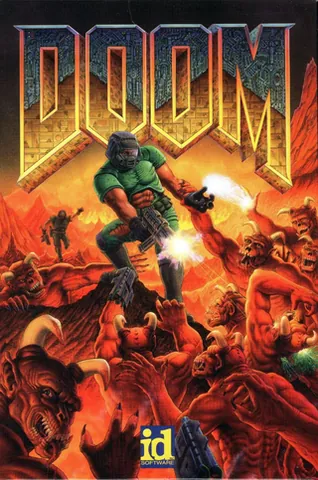 Doom DOS · VFX1 · 32X · Jaguar · PS4 · XONE · Switch · PC · 1993
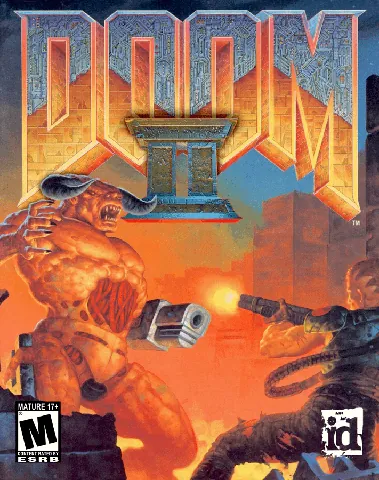 Doom II: Hell on Earth DOS · 1994
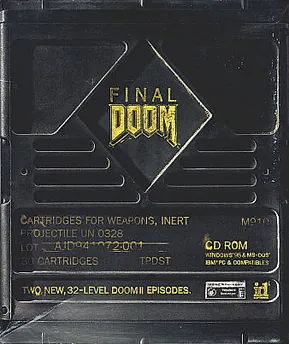 Final Doom PS1 · 1996
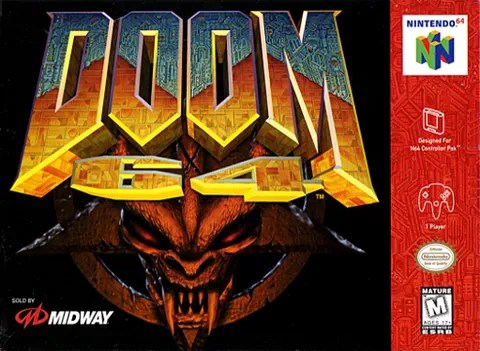 Doom 64 N64 · 1997
 Doom 3 PC · Xbox · 2004 Java ME Doom RPG Java ME · 2005
 Doom II RPG Java ME · 2009
 Doom VFR PSVR · 2017
 Doom Eternal PS4 · XONE · Switch · Series · PC · PS5 · 2020