Lotus III: The Ultimate Challenge
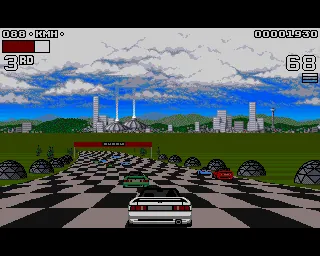

You sit behind the wheel, the engine roars, and the screen splits into two halves - this is the moment you remember why the Amiga was synonymous with home entertainment in the early 1990s. Lotus III: The Ultimate Challenge pushed the arcade racing series of the Lotus brand to the point where it was no longer just a sequel, but a generous celebration of speed. And it did so with a lightness that is remarkably addictive to this day.
The Lotus series was created by the British studio Magnetic Fields and the publisher Gremlin Graphics, one of the most prominent names on the European home scene of the time. After the success of the first two installments, the third sequel came as an answer to fans' expectations: fast, smooth, and built primarily for the feel of driving, not for simulation. Like much of the acclaimed software of the era, the game was tuned above all for the Amiga, where it managed to squeeze smooth scrolling and a brisk pace out of the hardware, before three-dimensional polygonal racing arrived and reformatted the entire category.
In terms of gameplay, Lotus III stands on several pillars that make it more than just another arcade game. The shared horizontal split of the screen allowed two-player play on a single computer - a duel with a buddy side by side was the heart of the whole fun and the reason people fired the game up again and again. The tracks alternate across different environments and conditions, from rain and fog to night sections, so each drive feels different. The driving force is pure speed and the feel of the car, not realistic physics models - exactly the kind of instant gratification that defined the genre.
The most interesting contribution of the third game was its track editor. Instead of a fixed set of circuits, the player got a tool with which to assemble their own sections and thus generate practically an endless number of new challenges. At a time when a game's content was measured by the number of pre-built levels, this was an unusually generous and modernly conceived feature that extended the title's lifespan far beyond the limits of ordinary racing games.
Culturally, Lotus III belongs to that layer of the Amiga catalog that still shapes the nostalgic image of the platform. Together with titles like Stunt Car Racer or later 3D races, it represents an epoch when racing games on home computers were played mainly for the joy of motion and for evenings spent with a buddy at a single keyboard or joystick. It's a game that needs no complicated manual or hours of learning - you get in and drive.
Why play: For the pure, instant joy of speed, two-player duels on one screen, and a track editor that gives the game practically endless longevity.
Game 51 of 121 for Commodore Amiga