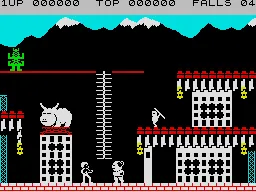
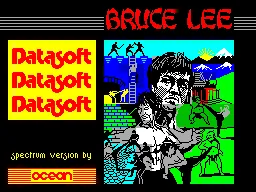
A leap across a chasm, a swing of the leg at a flying Ninja and an instant dodge away from Yamo's green mask — in the first seconds of Bruce Lee you learn that this game forgives very few. For the generation of Czech and Slovak players who had a Didaktik computer instead of the original Sinclair, this title was one of the most-played pieces of tape circulating among friends.
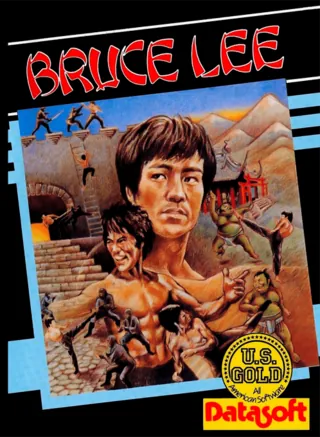
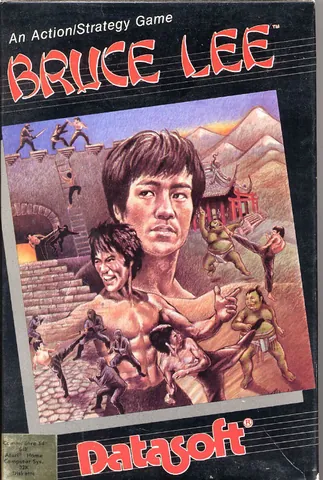
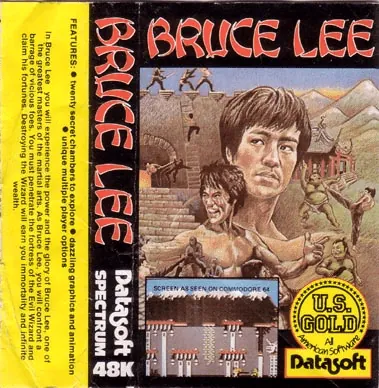
Bruce Lee was originally created by Ron J. Fortier for Datasoft and came out in 1984 on a whole range of eight-bits, including the ZX Spectrum, of which the Didaktik is a fully compatible clone. The principle is ingeniously simple: you pass through a series of single-screen rooms, collect lanterns hanging in the air and try to break through to the last evil wizard. The game combines a platformer with combat elements — kicks and punches are your only weapon against a pair of tireless opponents.
The highlight of the game is precisely that enemy pair. Yamo, a burly wrestler in a mask, and the black Ninja appear in practically every room and pursue you relentlessly. What is remarkable for its time, however: in two-player mode one could control Bruce and the other take over Yamo, so cooperation suddenly turned into a duel. This simple yet clever idea gave the game unexpected replayability.
Graphically Bruce Lee did not dazzle on the Spectrum, but the character animation was smooth and legible for 1984 and the controls responded exactly as the player needed in a game based on the timing of jumps and dodges. It was precisely this precision of control that made it a title people kept coming back to until they had beaten the whole castle right up to the final confrontation.
On the Didaktik, which was sold in Czechoslovakia as a more affordable alternative to foreign computers, Bruce Lee was among the absolute staples of every collection. Together with other Spectrum classics it shaped what today's rememberers recall under the term the golden era of home eight-bit gaming.
Why play it: A fast, addictive and mercilessly precise action platformer that is still a benchmark of simplicity taken to perfection — and for those who remember the Didaktik, literally a piece of childhood.
Game 29 of 100 for ZX Spectrum
The same title elsewhere (2)
The Atari 800 was one of the lead platforms and offered smooth animation and solid colour that other versions were often measured against. The Commodore 64 benefited from its SID chip, giving the music and sound effects more depth and the colourful character sprites cleaner contrast. On the ZX Spectrum, though, the game was held back by the platform's classic weakness — attribute clash, where neighbouring objects on an 8x8 block can only share two colours, flattening the scene — plus a weak beeper that could only manage simple tones instead of music. Anyone chasing the experience closest to the original should pick the Atari or C64 version; the Spectrum port is really for fans of that era's home-computer scene.