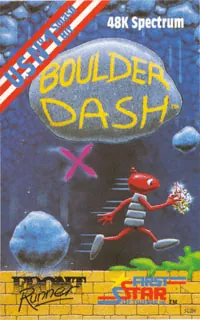
Boulder Dash
Digging your way through the dirt, collecting diamonds and dodging a falling boulder in time — that is a principle that has been entertaining players across generations for four decades now. Boulder Dash is one of the most influential logic-action games of all, and on the eight-bit computers it became an absolute classic.
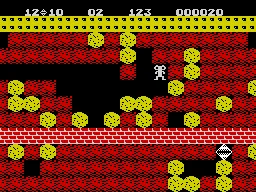
The game was originally created by Peter Liepa and Chris Gray and first came out in the mid-eighties. You control a little character named Rockford, who digs through caves, collects the required number of diamonds and heads for the exit. The genius lies in the physics of the environment: boulders and gems are subject to gravity, they fall, roll and can crush you. Each level is thus really a puzzle about the correct order of digging, combined with quick reflexes and the threat of enemies and the ticking clock.
Boulder Dash spread to practically every home computer of its day and became the template for countless imitations and clones. On the Spectrum and compatible machines, which included the Slovak Didaktiks, it was among the titles that people passed around and played again and again, because its principle is immortal.
The game's significance is shown by how deeply it influenced the whole genre. The mechanic of falling objects and digging appears in a host of later games, and the Boulder Dash brand itself has seen many official sequels and modern versions on contemporary platforms.
For players on the Didaktik, Boulder Dash represented the ideal blend of thinking and action: it is easy to understand but very hard to master perfectly. It was precisely this balance that made it a timeless title to which retro enthusiasts happily return.
Why play it: For a timeless combination of puzzle and action that has aged absolutely minimally and is just as addictive as it was forty years ago.
Game 28 of 100 for ZX Spectrum
The same title elsewhere (3)
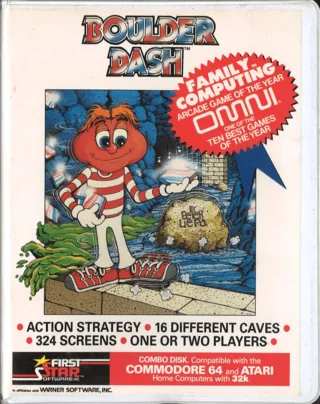
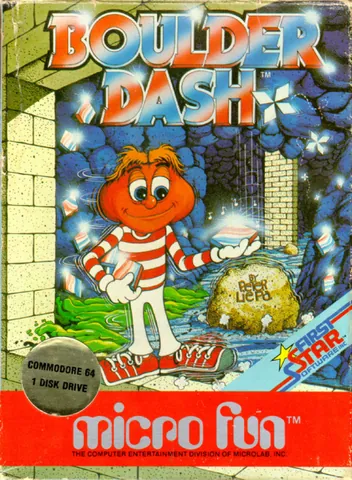
Boulder Dash launched simultaneously on Atari 8-bit and Commodore 64 in 1984, and both versions still rank among the best-regarded – Atari benefited from smooth hardware scrolling and snappy response, while the C64 offered bolder colours and the SID chip gave it a distinctive score. On the ZX Spectrum, development hit the machine's classic limitation: attribute clash meant each tile could only carry a restricted colour combination next to its neighbours, making the playfield flatter and less colourful than on the Commodore. The Amstrad CPC sits closer to the C64 colour-wise, though its processor gives the game a slightly different pace. The core loop stays the same everywhere, just dressed differently.