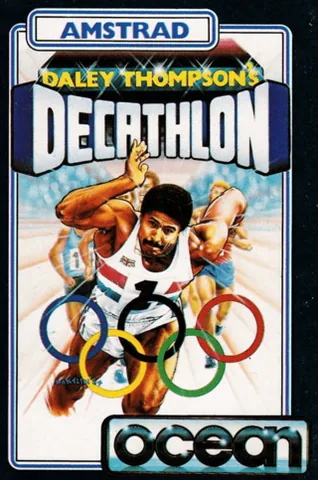
Daley Thompson's Decathlon
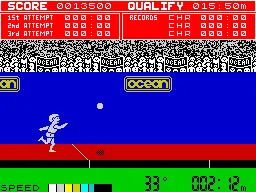
If you grew up with the rubber keyboard of the ZX Spectrum, you know the sound: the desperate hammering on the keys and the cracking of joysticks that had no chance of surviving. Daley Thompson's Decathlon is a legend among the sports games of the eighties and a synonym for utterly destroyed controllers.
The game's principle is brutally simple and all the more addictive for it. Ten athletics disciplines, from sprints through jumps to throws and puts, and in the vast majority of them a single thing decides it: how fast you can waggle the controls. The faster you alternate the buttons or jerk the joystick, the faster your athlete runs and the further he jumps or throws. Add to that the timing for the right take-off or throwing angle. It is a pure physical test of the player, not of the character on the screen.
The game capitalised on the name of Daley Thompson, the British decathlete and Olympic champion who was a national hero at the time. Pairing a popular sportsman with the home microcomputer that ruled Britain was a winning combination. The ZX Spectrum was the heart of the British gaming scene of the eighties, and this game belongs to it inseparably.
The cultural mark of this game is that it became a textbook example of the whole subgenre of so-called joystick-wrecker sports games. It inspired countless imitations and became a symbol of gaming evenings when friends took turns at the keyboard and competed for the best performances while wrecking both their fingers and their hardware.
Today Daley Thompson's Decathlon is a memory of a time when gaming was literally a sweat-soaked physical activity. It is merciless, it is primitive, but it is precisely in that raw competitiveness that its magic lies, one that still works to this day, especially with two or more people at one machine.
Why play it: For the pure, sweat-drenched competitiveness of a classic sports game that defined a whole era of key-hammering on British microcomputers.
Game 30 of 100 for ZX Spectrum
The same title elsewhere (1)
This was a game played mostly with your hands and wrists: frantic key-mashing or joystick-waggling decided the outcome of every event, and both home versions relied on exactly that. The ZX Spectrum version came first and became notorious for wrecking joysticks — and even the computer's own rubber keyboard — within weeks. The Amstrad CPC version arrived two years later and benefited from a more colourful video chip and the AY-3-8912 sound chip, so the game felt livelier and the music had more variety than the Spectrum's simple beeper bleeps. The gameplay and pace stayed the same; the real difference lies in the audiovisual polish, and in which machine you have a spare joystick ready for.