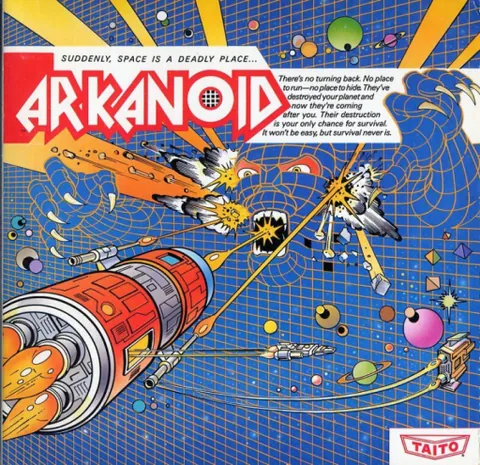
Arkanoid
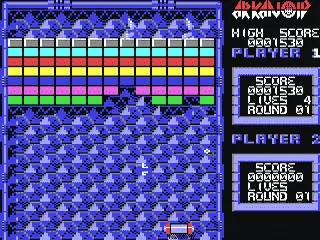
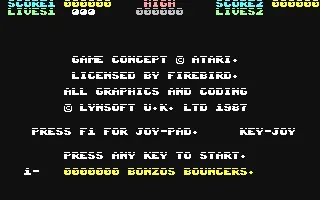
The paddle at the bottom, bricks at the top, and a ball that bounces exactly where you didn't want it — Arkanoid elevated the good old Breakout into a fast, addictive arcade game you can't stop playing. On the Commodore 64 its conversion is among the best home versions this game ever received.
The mechanics are perfectly polished: you bounce the ball, smash blocks, and try to clear the screen, but power-ups pile up and change everything. Extending the paddle, several balls at once, a laser, or catching the ball — each falling bonus is a decision about whether to risk going for it. Some levels end with a boss fight and the pace keeps rising, so you need precision and lightning reflexes. This layer of tactics over a simple base makes Arkanoid far more than just a "brick breaker."
The original arcade machine comes from the Japanese studio Taito and was released in the mid-eighties; the home conversions spread around 1987. The version for the Commodore 64 earned a reputation as one of the most successful home conversions — it preserved the smoothness of the controls and that nervy speed of the bounces on which the whole game rests.
Culturally, Arkanoid revived the entire genre of block-breakers and defined its modern form for decades to come. It became the benchmark against which all later games of this type are compared, and its power-ups became a genre standard. For owners of the Commodore 64 it was one of the games over which people most often competed for the highest score.
Today Arkanoid works just as it always did: you sit down, catch the rhythm, and suddenly it's midnight. It's pure, instant fun where everything is decided by your precision and a cool head amid the chaos on the screen.
Why play: A precise, addictive block-breaker in one of the best home versions — the ideal game for "just one more try" that stretches into an hour.
Game 5 of 121 for Commodore 64
The same title elsewhere (1)
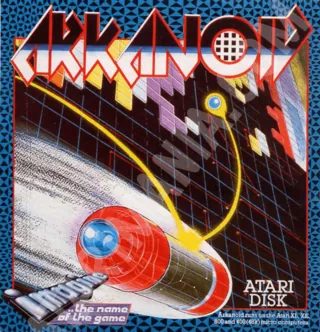
The Taito arcade original ran on powerful cabinet hardware, delivering smooth motion, bright colors and pixel-precise ball bounces that home 8-bit machines struggled to match. The Commodore 64 conversion has long been rated among the best home ports of the game — it keeps the brisk pace, colorful bricks and a punchy soundtrack thanks to the SID sound chip. The Atari 800 version offers the same core gameplay but with simpler graphics and fewer details, typical of 8-bit arcade conversions of the era. Anyone wanting to experience Arkanoid in its best home form today should reach for the Commodore 64; the Atari version is mostly a historical curiosity.