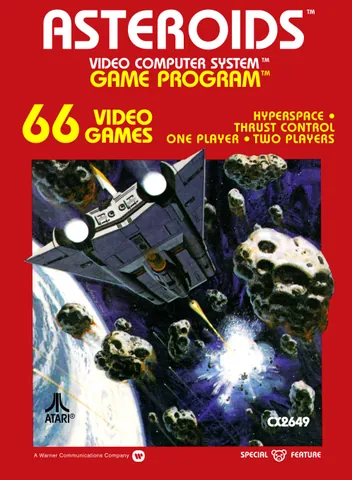
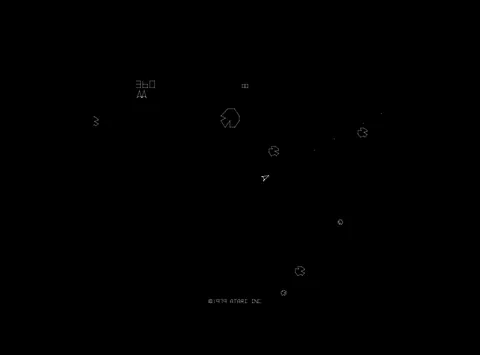
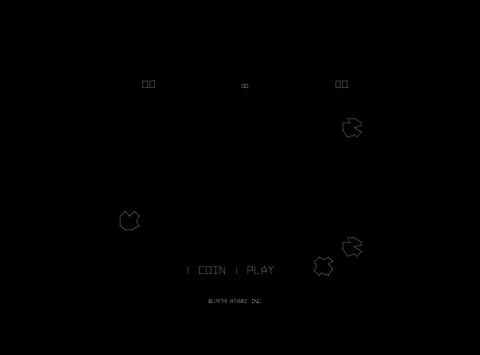
A black screen, white vector lines, and a lone triangular ship in the middle of infinite space. Asteroids from 1979 is one of the purest and most influential games Atari ever released into the world, and it defined the shape of arcades for years to come.
The gameplay is the essence of cosmic action. Large asteroids drift lazily around you, and your task is to shoot them to pieces. But each hit shatters a big boulder into smaller and faster fragments, so the screen suddenly fills with a swarm of deadly rocks. On top of that, an enemy flying saucer arrives from time to time and fires at you with precision. You steer the ship by inertia, according to the laws of Newtonian physics, so every acceleration must be skillfully countered with a reverse thrust.
Asteroids was designed by Lyle Rains and Ed Logg, and the game used vector graphics that drew sharp, glowing lines instead of pixels. The result was visually exceptionally elegant for its day. The game became one of Atari's greatest commercial successes ever and long ranked among the most profitable cabinets in American arcades. It was also one of the first games to allow players to enter their name into a high-score table.
The cultural impact was enormous. Asteroids became a symbol of the early video game era, and to this day you'll find it in all sorts of compilations, remasters, and tributes. The principle of breaking large objects into smaller ones became one of the fundamental gameplay mechanics copied by dozens of later titles.
Even after more than four decades, the game is addictive thanks to the tension that springs from the gradually thickening screen and the inertial controls. You have to think ahead, conserve space, and not panic when everything around you is moving at once. It's a perfect balance between simplicity and depth.
Why play: For the ageless elegance of vector graphics and the pure, suspenseful gameplay that still ranks among the pinnacles of arcade minimalism.
Game 38 of 258 for Arcade
The same title elsewhere (1)
The Atari arcade original ran on a genuine vector monitor that drew thin, crisp lines for the ship and rocks directly with the electron beam, so the image stayed clean regardless of resolution. The Atari 2600 has no vector display — its picture is built from the blocky raster shapes typical of the TIA chip, so ships and rocks look coarser and less elegant. The console can also only show a limited number of objects at once, so asteroid density and pacing had to be toned down compared to the arcade. Sound is simple on both sides, but the synthesized explosions and the rising engine pulse from the arcade board carry more atmosphere. For the true vector cleanliness, the arcade version is where to go.