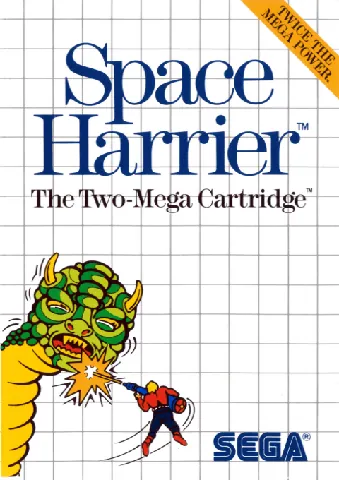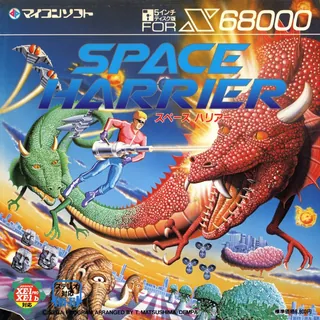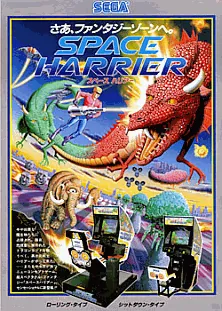
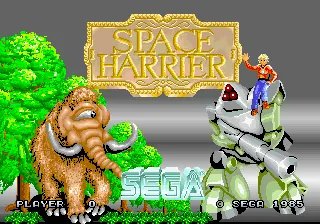
"Welcome to the Fantasy Zone. Get ready!" – this digitized opening line meant that in a moment a colorful, surreal world full of flying mammoths, stone columns and dragons would come rushing at you. Space Harrier by Sega from 1985 was one of the titles that defined what arcade spectacle meant in the mid-1980s.
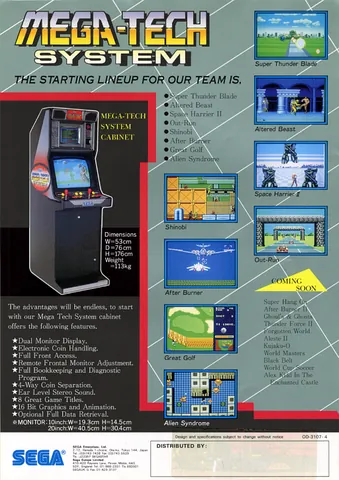
The game was designed by a team led by Yu Suzuki, one of the most influential figures of the arcade era. Space Harrier became famous for its so-called "taikan" cabinet version – a luxurious housing that tilted and moved with the player's motions, so that you physically experienced every dodge. It turned a trip to the arcade into an experience that home consoles simply couldn't offer at the time.
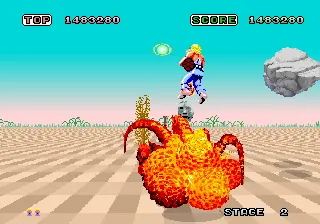
As for gameplay, it's a rail shooter running into the depth of the screen. You control a character armed with a laser cannon who alternately runs and flies through a pseudo-3D space toward enemies and obstacles. The pseudo-3D sprite scaling – objects smoothly grow larger as they approach you – created an illusion of speed and depth that was breathtaking at the time. Reflexes are everything: you have to face dodging obstacles and salvos of projectiles within fractions of a second.
Space Harrier's cultural footprint is enormous. The Fantasy Zone in which the game takes place links Sega's gaming universe across titles, and the main hero became one of the brand's icons. Hiro Kawaguchi's music ranks among the most memorable arcade melodies ever. The game received a number of ports and sequels, among others on systems like the Sega 32X, and it appears in all sorts of compilations to this day.
Space Harrier is often mentioned in the same breath as Suzuki's other "super scaler" games such as Hang-On and After Burner – titles that pushed Sega's hardware to the limit and defined an era when the arcade was technologically far ahead of the living room. Even after decades, Space Harrier retains a hypnotic, dreamlike charm unlike anything else.
Why play: The surreal Fantasy Zone, a dazzling illusion of speed and Suzuki's immortal spectacle – Space Harrier is pure arcade joy that ages with grace.
Game 45 of 258 for Arcade
The same title elsewhere (2)
The arcade original relied on dedicated sprite-scaling hardware that let the terrain and enemies grow and shrink smoothly at high speed — that pseudo-3D illusion of fast flight was the game's main draw. The Master System has no such scaling circuitry, so the conversion had to simplify the effect: objects zoom in more abruptly, fewer enemies appear on screen at once, and the overall pace is slower than in the arcade. The colour palette and music on the 8-bit machine naturally fall short of the arcade board's quality. For the purest sense of speed and smoothness, the arcade original remains the definitive version, while the Master System offers a solid but simplified home substitute.