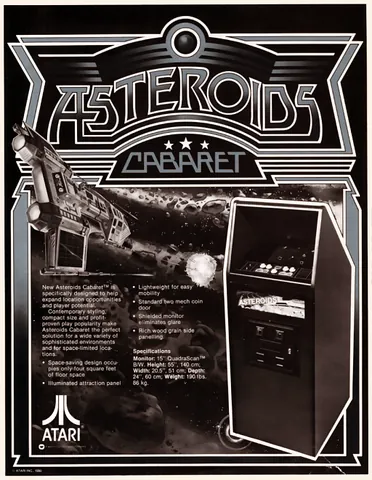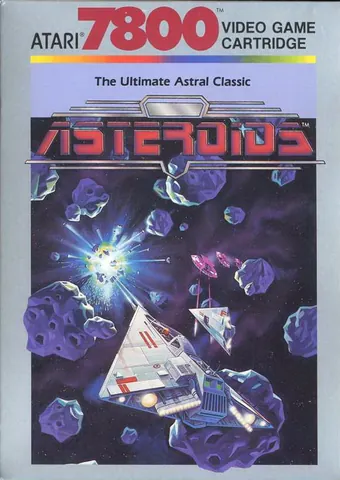
A black background, white outlines and a lone little ship in the middle of endless space — Asteroids is a game reduced to its very essence, and it is precisely in that purity that its immortality lies. Atari's arcade original from 1979 was among the peaks of vector graphics, and the home port on the 2600 brought this hungry fight for survival into millions of households.
The task is simple and at the same time merciless: in your ship you rotate in the middle of the screen, propel yourself with the engine's thrust and shoot at the drifting asteroids. Every larger rock, when hit, breaks into smaller and faster fragments, so instead of relief comes even greater chaos. In between, a flying saucer occasionally sweeps in, firing at you with unpleasant precision. The ship's inertia, constantly gliding through space, turns every maneuver into a tiny life-or-death decision.
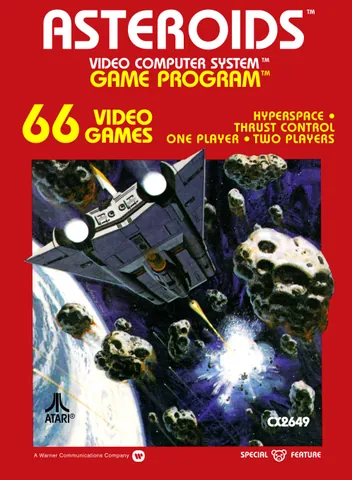
The home version on the Atari 2600 was exceptionally well done for its time and became one of the console's best-selling titles. To fit so many objects and variants onto the screen, the programmers reached for a technical trick called bank switching, which allowed the use of a larger cartridge and offered dozens of game variants — from different numbers of asteroids to a two-player mode.
Arcade Asteroids also went down in history as one of the first games to let players enter their initials on the high-score list, thereby strengthening the competitive spirit of the arcades. Together with Space Invaders it was among the titles that defined the golden age of arcades at the turn of the seventies and eighties.
The game's minimalist look, stemming from vector monitor technology, became a timeless icon. Asteroids is today synonymous with the early era of video games, and its simple but brutally addictive loop inspired countless followers.
Why play: A perfect demonstration that great game design needs nothing more than a few shapes and a brilliant idea — Asteroids pulls you in within seconds and won't let go.
Game 13 of 69 for Atari 2600
The same title elsewhere (2)
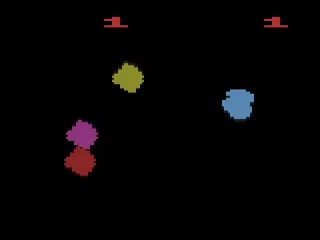
The Atari arcade original ran on a genuine vector monitor that drew thin, crisp lines for the ship and rocks directly with the electron beam, so the image stayed clean regardless of resolution. The Atari 2600 has no vector display — its picture is built from the blocky raster shapes typical of the TIA chip, so ships and rocks look coarser and less elegant. The console can also only show a limited number of objects at once, so asteroid density and pacing had to be toned down compared to the arcade. Sound is simple on both sides, but the synthesized explosions and the rising engine pulse from the arcade board carry more atmosphere. For the true vector cleanliness, the arcade version is where to go.