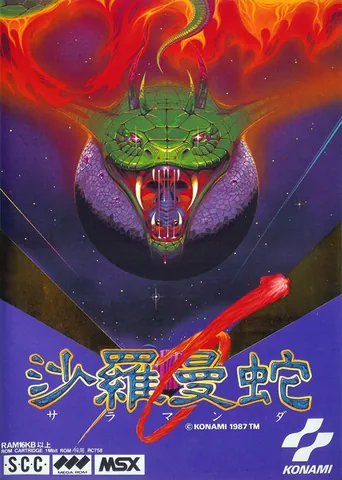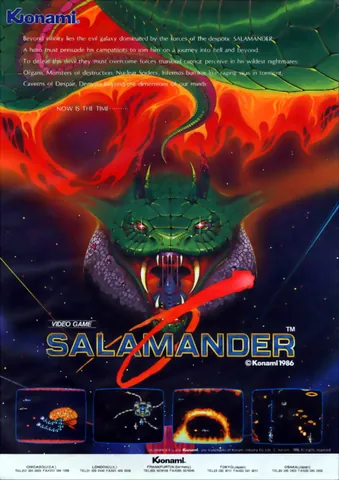
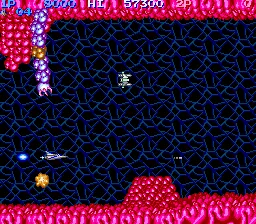
A cosmic beast undulates across the screen, organic tunnels pulse like the innards of a gigantic creature, and you weave between them in a metal ship that will soon dominate the whole experience. Salamander is an arcade shmup from Konami, and in a sense it's the rebellious child of the legendary Gradius – it shares its DNA, but in many places it goes its own, harsher way.
The most visible difference is that Salamander alternates between horizontally and vertically scrolling levels, which was a refreshing change from strictly horizontal shooters at the time. The second big novelty is simultaneous cooperation between two players – two ships throw themselves into the action at once, which turned the arcade into a social experience full of shouting and mutual accusations over who stole whose power-up.
Instead of the classic upgrade bar that Gradius made famous, here you collect upgrade icons directly from defeated enemies. You gradually assemble your loadout – speed, an option (small satellites copying your fire), missiles, and a stronger laser. The philosophy stays the same: the farther you get, the more dangerous it is to lose it all, because death returns you to a defenseless state. This cruel curve of risk and reward is the essence of the genre.
Visually, Salamander captivated with its biomechanical, at times almost disturbingly organic environments. Pulsating walls, fiery eruptions inspired by the Sun, and giant bosses gave the game an atmosphere that stood apart from the purely technical look of the competition. The music and sound underscored the tension at every moment when the screen filled with projectiles.
The game saw a number of ports to home systems, and in various regions it was also released under the name Life Force, often with adjusted difficulty or story background. In the context of eighties Konami, it was one of the building blocks of their reputation as masters of the shooter genre, alongside Gradius, TwinBee, and others. For shmup fans, Salamander remains an essential item – a title that showed you could experiment with the format even within an established series.
Why play: If you love classic shooters, Salamander offers a sharp, cooperative experience with an unmistakable biomechanical atmosphere and clever alternation of scrolling directions.
Game 44 of 258 for Arcade
The same title elsewhere (2)
The Konami arcade version ran on its own sound and graphics board, handling smooth transitions between horizontal and vertical sections and simultaneous two-player action without slowdown, with music carrying a full, layered sound from dedicated hardware. The MSX port had to work with the home computer's considerably weaker graphics chip, so scrolling looks blockier and the color palette narrower, while the music sounds thinner since the MSX sound circuit has fewer channels than the arcade board. Konami knew the MSX well and treated it almost like a second home platform, so they tried to preserve gameplay as faithfully as possible despite the visual compromises. The arcade rendition remains the smoothest and richest-sounding version of the game.