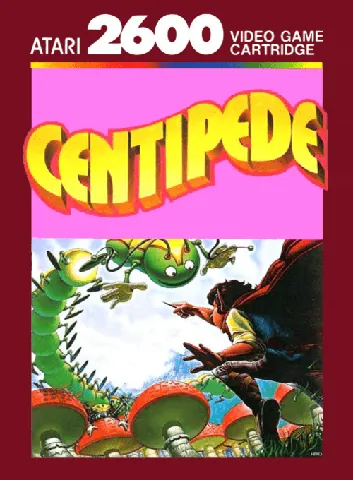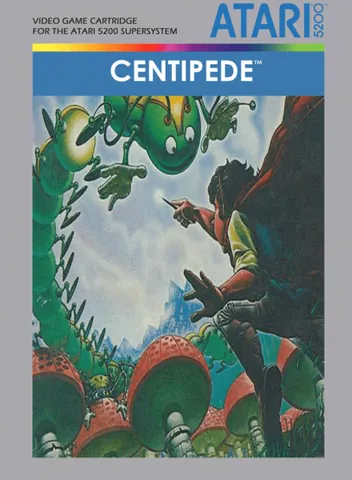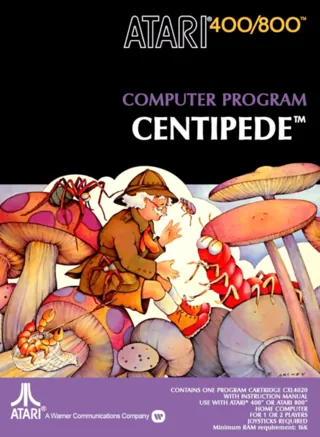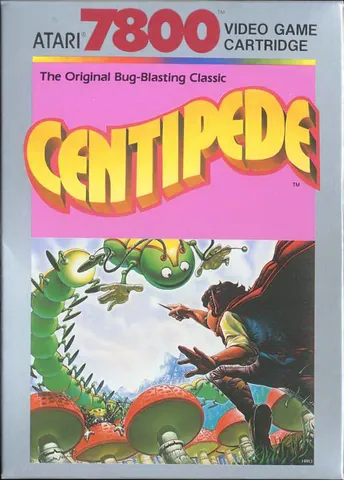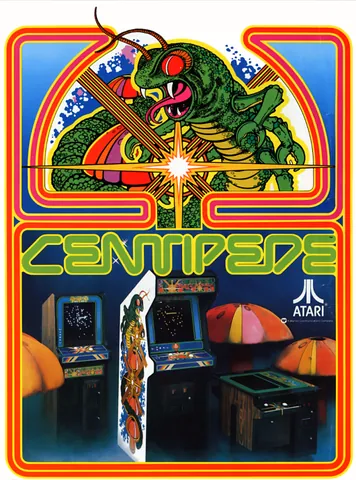
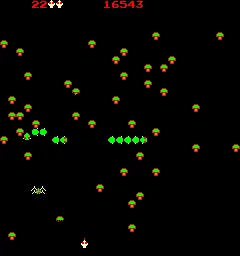
A segmented centipede winds its way down from the top edge of the screen, a venomous spider darts among the mushrooms, and you frantically fire into that teeming mass of legs. Centipede from 1981 ranks among the most famous titles from the Atari studio and is still a textbook example of perfectly tuned arcade action.
The game's genius lies in its adversary. The centipede weaves through a field of mushrooms, and each time you hit it in the middle of its body, it splits into two separate, shorter centipedes, each of which starts crawling on its own. Meanwhile the mushrooms multiply and gradually turn the playing field into a maze. Add to that a pesky spider, a flea dropping from above, and a scorpion poisoning the mushrooms, and you have a recipe for a chaotic but wonderfully readable onslaught of enemies.
Centipede is also exceptional in that Dona Bailey, one of the few female programmers in the then male-dominated world of the game industry, worked on its design together with Ed Logg. The game was controlled with a trackball, which allowed fast and precise movement of the shooter along the bottom strip of the screen. It was precisely this fluidity that made Centipede one of the most tactile arcade experiences of the time.
Culturally it was a breakthrough for several reasons. The vivid color palette and the relatively peaceful insect theme drew female players to the cabinet as well, which was a rarity in the arcades of the era. The game was ported to countless home systems including the Atari 2600 and 5200, and got a sequel called Millipede, which expanded the concept with even more critters.
Today's player will appreciate how splendidly Centipede has aged. The pace escalates relentlessly, the screen fills with mushrooms, and you have to decide in fractions of a second who to take down first. It's a demonstration that timeless design needs nothing more than a clever enemy and precise controls.
Why play: For the hypnotic rhythm, a cleverly designed enemy that splits right before your eyes, and a piece of history that one of the first women in the field helped create.
Game 37 of 258 for Arcade
The same title elsewhere (4)
The 1981 arcade original remains the benchmark, with smooth animation of the centipede and its swarm of spiders and fleas against brightly colored mushroom fields. The Atari 2600 port ranks among that machine's best-regarded conversions — unlike the infamously botched Pac-Man port, developers here kept the gameplay and pace intact despite blockier graphics and the 2600's limited palette. The Atari 5200 had stronger hardware, so its version offered smoother movement and colors closer to the arcade original than the older 2600. Anyone wanting the truest experience should choose the arcade version, while anyone after the best early-1980s home conversion will appreciate the Atari 5200.