Space Harrier
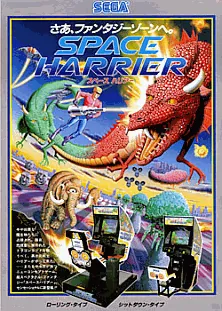
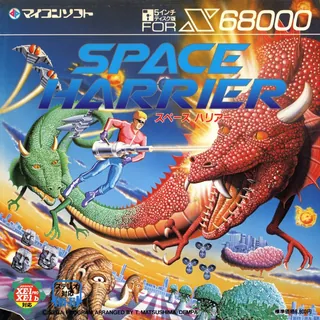
Space Harrier is among the most famous arcade machines of the eighties, and its conversion to the Sharp X68000 was seen in Japan as a small miracle. Playing a flying hero with a laser cannon, you rush into the depth of the screen across the surrealist Fantasy Zone, where flying dragons, stone heads, mechanical enemies and checkerboard-colored fields with scattered trees await. The gameplay is extremely simple, yet surprisingly demanding thanks to its speed and density: the hero can move across the entire screen, shoots forward, and must dodge projectiles and obstacles that approach from a distance at breakneck speed. Each stage ends with a boss fight, each with its own movement pattern.
The original ran on an expensive machine with a moving cabinet and hardware built for scaling giant sprites, which was a nightmare for home systems in the eighties. The X68000 had enough power and colors to pull off a convincing illusion of speed with large, smoothly scaling objects, and as a result this conversion stood out above all competing versions on the market at the time. The music is unmistakable, cheerful and driving forward, and in its Yamaha FM chip version it retains its infectiousness; together with the digitized voice clips at the start of the game, it rounds out the atmosphere of a colorful dream that makes no sense and doesn't intend to.
At the time, this conversion served as proof that the X68000 truly was a home arcade machine, and together with other conversions from the same publisher it defined the platform's reputation. Space Harrier's influence on the genre is fundamental: it stood at the birth of what came to be called super scaler games, influenced an entire generation of fast-paced action titles, and its aesthetic is still cited today in stylized indie games and in music. Today it's a short, intense experience you can play through in twenty minutes and then keep returning to for the score. It feels like pure distilled fun, nothing about it has aged a day.
Game 11 of 25 for Sharp X68000
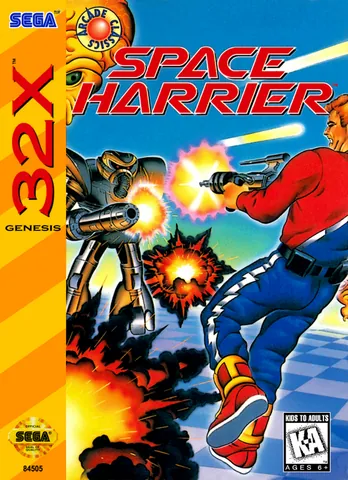
The same title elsewhere (3)
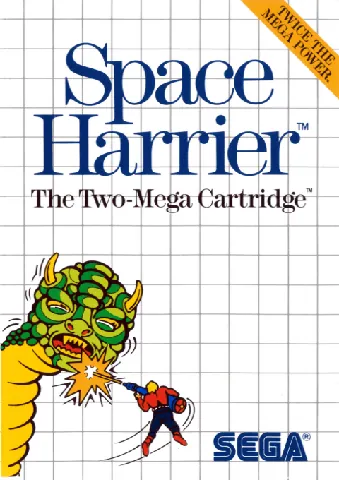
The arcade original relied on dedicated sprite-scaling hardware that let the terrain and enemies grow and shrink smoothly at high speed — that pseudo-3D illusion of fast flight was the game's main draw. The Master System has no such scaling circuitry, so the conversion had to simplify the effect: objects zoom in more abruptly, fewer enemies appear on screen at once, and the overall pace is slower than in the arcade. The colour palette and music on the 8-bit machine naturally fall short of the arcade board's quality. For the purest sense of speed and smoothness, the arcade original remains the definitive version, while the Master System offers a solid but simplified home substitute.