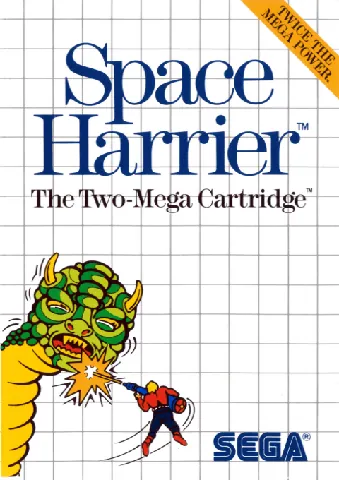
Space Harrier
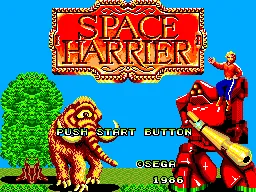
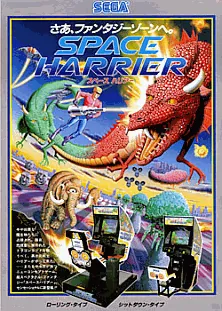
„Welcome to the Fantasy Zone. Get ready!“ — few opening lines are as iconic as the one from Space Harrier, the surreal rail shooter that legendary Yu Suzuki and his team at Sega AM2 unleashed into the arcades in 1986.
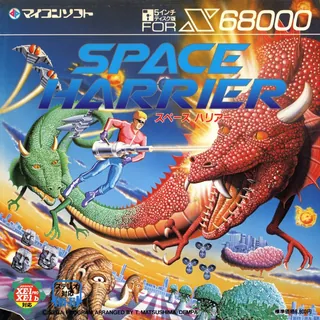
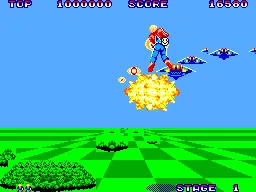
The game hurls you straight into the screen: you charge through an endless pseudo-3D landscape full of checkered floors, floating stone columns, two-headed dragons and outlandish creatures. You control a hero with a laser gun who runs and mows down waves of enemies and giant bosses on the fly. It's not a classic shooter with free movement — it's about dodging, rhythm and reflexes at full speed.
The arcade original was a technical sensation: it ran on a moving hydraulic cabinet that tilted and swayed according to the on-screen action, so the player literally felt every evasive maneuver. Suzuki's flair for spectacle and speed here foreshadowed his later work on games like OutRun and Virtua Fighter.
Bringing this to the 8-bit Master System was a bold feat, and the result is technically impressive given the hardware's capabilities — the scaling of objects and the illusion of depth don't reach arcade fluidity, but the sense of dizzying speed and that unmistakable dreamlike world remain. Add the catchy, still-remembered music.
Space Harrier became one of the defining titles of the „super scaler“ technology era and returns repeatedly in compilations and in references in other Sega games. For retro fans it's a window into a time when arcades competed for attention through pure spectacle and sensory experience.
Why play: For the genuine adrenaline and surreal atmosphere of one of the most stylish rail shooters Sega ever created.
Game 17 of 67 for SEGA Master System
The same title elsewhere (2)
The arcade original relied on dedicated sprite-scaling hardware that let the terrain and enemies grow and shrink smoothly at high speed — that pseudo-3D illusion of fast flight was the game's main draw. The Master System has no such scaling circuitry, so the conversion had to simplify the effect: objects zoom in more abruptly, fewer enemies appear on screen at once, and the overall pace is slower than in the arcade. The colour palette and music on the 8-bit machine naturally fall short of the arcade board's quality. For the purest sense of speed and smoothness, the arcade original remains the definitive version, while the Master System offers a solid but simplified home substitute.