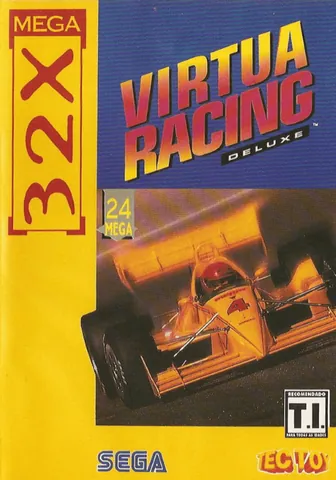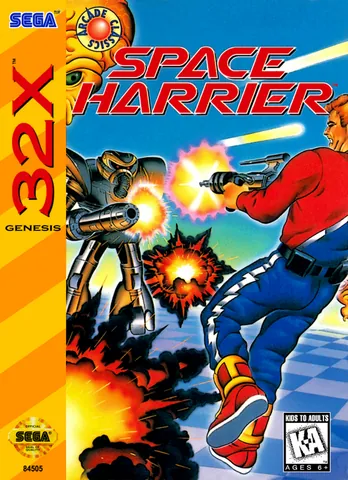
Space Harrier
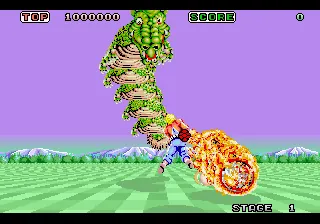
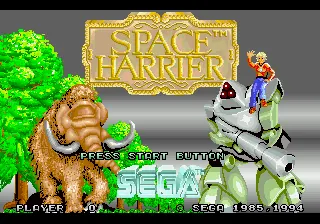
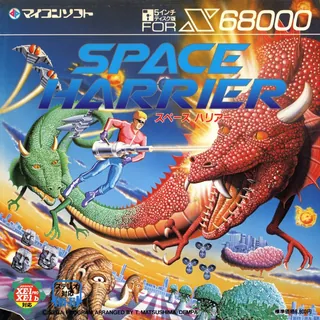
Space Harrier arrived on the 32X as a faithful conversion of one of Sega's most iconic arcade games. A hero with a jet pack on his back flies toward the screen through an endless fantastical landscape, shooting at everything coming at him and dodging pillars, rocks, and enemy fire. The rules are as simple as they were the year the original came out: one hit means losing a life, the path can't be slowed or stopped, and the only thing keeping the player afloat is finely honed movement and the ability to read where the shots are going to fly. Each level ends with a boss, from winged dragons to giant heads spewing projectiles. The game doesn't try to tell a story or explain where the hero came from — the whole world is simply a backdrop for the forward flight.
The add-on conversion managed to put its power to use for exactly what the game is built on — smooth, fast scaling of objects that creates the sensation of a mad flight forward. Scenery approaches without tearing, the colorful checkerboard plains rush by briskly, and the game keeps its sharp, richly colored look, complete with the typically bizarre bestiary of flying creatures. The sound picks up the arcade cabinet's famous melodies and voice samples, which still rank among the most memorable in Sega's whole catalog. It's exactly this combination of pace, color, and music that makes Space Harrier an experience whose rhythm stays in your head even after just a few minutes.
At the time, the conversion was praised as one of the most faithful home versions, though some reviewers complained that this was, after all, a mid-1980s game released in 1994. The influence of the original on the genre, meanwhile, is enormous: it defined the category of shooters viewed from behind the character, and its technology helped build Sega's reputation as the master of arcade speed. Today it's an ideal title for a short session — it has aged gracefully, because it never relied on anything but pure movement. On the 32X, it also ranks among the versions worth firing up even today, if you want to hear and see exactly why people still talk about this classic.
Game 9 of 15 for SEGA 32X
The same title elsewhere (1)
The arcade original relied on dedicated sprite-scaling hardware that let the terrain and enemies grow and shrink smoothly at high speed — that pseudo-3D illusion of fast flight was the game's main draw. The Master System has no such scaling circuitry, so the conversion had to simplify the effect: objects zoom in more abruptly, fewer enemies appear on screen at once, and the overall pace is slower than in the arcade. The colour palette and music on the 8-bit machine naturally fall short of the arcade board's quality. For the purest sense of speed and smoothness, the arcade original remains the definitive version, while the Master System offers a solid but simplified home substitute.