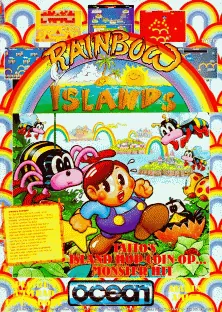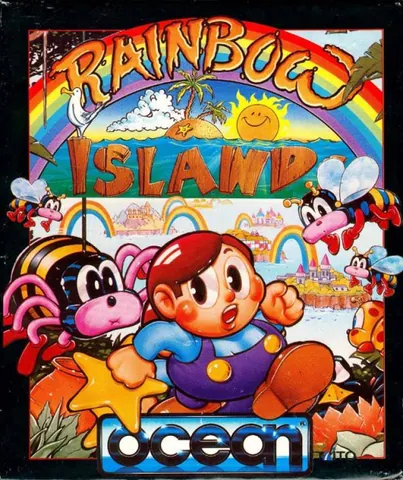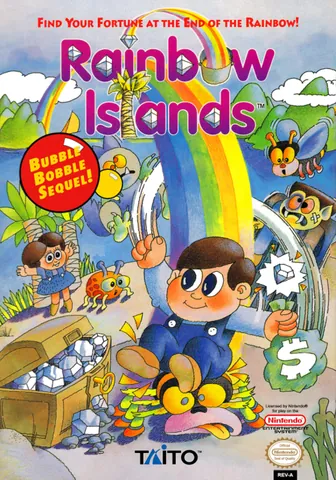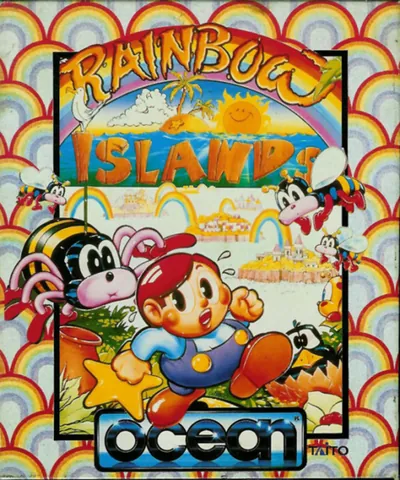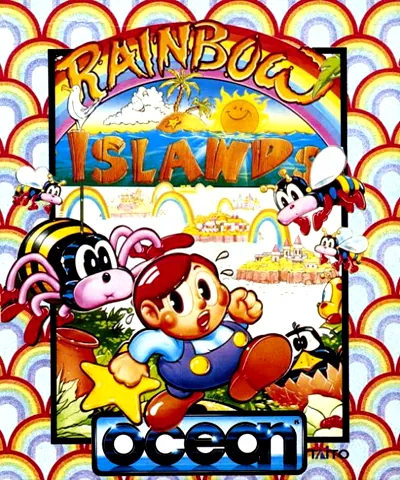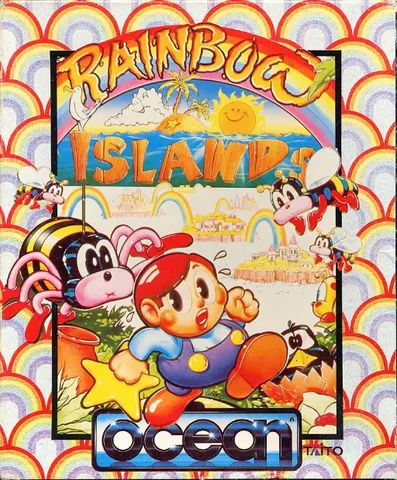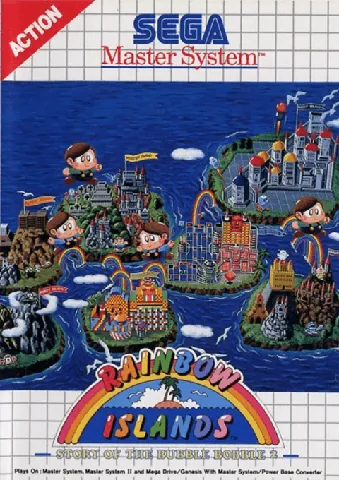
Rainbow Islands
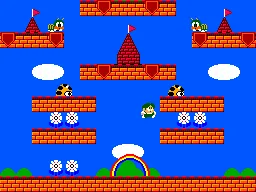
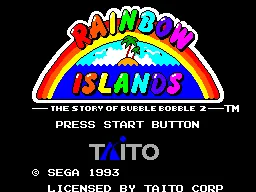
Climbing upward along rainbows you conjure yourself and drowning enemies in a colourful cascade — Rainbow Islands is one of those games where a few seconds are enough and a smile appears on your face automatically. This fresh, colourful platformer is a direct sequel to the legendary Bubble Bobble and carries the subtitle Story of Bubble Bobble 2.
The game principle is ingeniously simple yet deep. Your character doesn't attack conventionally but fires rainbows. These serve at once as a weapon to knock down an enemy, as a step to jump higher on, and as a trap when you let a rainbow fall onto an opponent's head. The goal of each level is to climb to the top before the rising water catches up with you. Collecting diamonds in the correct colour order also unlocks bonuses and a hidden ending, so beneath the cute surface hides a surprisingly tactical game.
Rainbow Islands was created at Taito and arrived in arcades in 1987. Behind the game stand the creators associated with the earlier hit Bubble Bobble, so the series shares the same playful, childishly colourful spirit. The game gradually made it onto a whole range of home platforms, and the eight-bit SEGA Master System was among the consoles on which players could enjoy it at home.
Culturally, Rainbow Islands is today considered one of the peaks of the so-called arcade platformers of the late eighties. The combination of instantly understandable controls and depth for advanced players is exactly the type of design that ages well. The rainbow as a universal tool is cited to this day as an example of an elegant game mechanic.
The Master System version had to compromise on the colourfulness and smoothness of the arcade original, but the essence of the fun stayed intact. For SEGA console owners it was a welcome piece for a collection of cheerful, unassuming-looking but surprisingly addictive games one gladly returns to.
Why play it: For instantly graspable, sunnily colourful fun that hides unexpected depth beneath its cute surface.
Game 30 of 67 for SEGA Master System
The same title elsewhere (6)
Rainbow Islands, the sequel to Bubble Bobble, differed across platforms mainly in how much colorful variety and smooth rainbow-climbing each system's hardware could handle. Taito's arcade machine remains the reference experience, with the richest color palette and smoothest movement. Amiga and Atari ST came closest to it, preserving both color and music. The 8-bit computers Commodore 64, ZX Spectrum, and Amstrad CPC had to limit on-screen colors and simplify backgrounds to keep scrolling playable, yet thanks to great music they earned their own loyal fans. The NES version was a direct rework by Taito with its own graphical style suited to the Nintendo console. SEGA Master System got a colorful conversion considered one of the nicer-looking ones among 8-bit consoles.