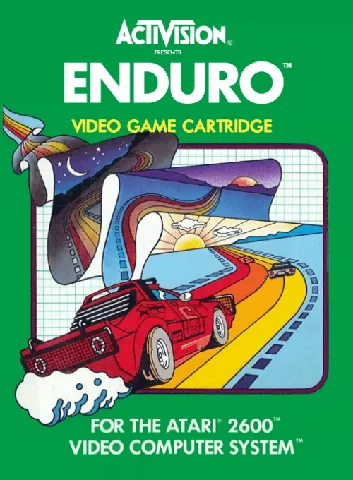
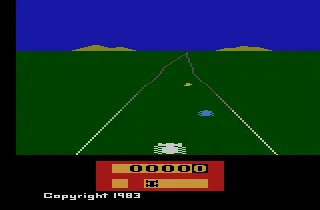
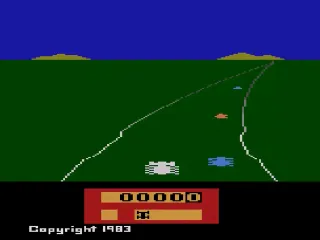
The sun rises, the fog lifts and your hands are already on the wheel. Beneath you an endless road unspools and the only task is simple: overtake a given number of cars before the day tips into night and night into a new day. Welcome to Enduro, one of the most addictive racing games that ever brought the wood-paneled Atari 2600 to life.
Enduro came out in 1983 from the Activision workshop, credited to designer Larry Miller. Activision was then the first independent game studio, founded by former Atari programmers who wanted their names finally to be heard. And Enduro is exactly the type of title that proved that independent audacity: on hardware with a few kilobytes of memory it managed to conjure a smooth illusion of speed that other racing games of the time could hardly match.
Enduro's genius lies in the rhythm of a single day. The goal of each round is to overtake a set number of cars by the end of the day; when you succeed, the game continues with another day at an even higher demand. In between, though, the conditions change: fog descends, it snows, the sun sets, the dawn dazzles you. Each change of weather transforms visibility and handling, so a game that looks like a simple loop actually keeps sliding new obstacles at you. It is the pure essence of an endless arcade challenge.
Culturally, Enduro belongs to the titles that defined what it means to "race" on a home console a generation before 3D graphics arrived. Activision was also famous for its patch system: players who managed several days in a row could send photos of their screen and earn a Roadbusters cloth patch. This community game around scores was a revolutionary form of connection between developer and player for its time.
Thanks to emulation and official compilations (Activision repeatedly released its classics in modern packages), Enduro appears to this day in retro collections and runs without a hitch on handhelds and in the browser. It still works exactly as it should: you're just cruising along for a while and suddenly you realize it's midnight both outside and on the screen.
Why play: A masterful lesson in wringing maximum tension from minimal hardware. One of the best-aged racing works of the Atari 2600 era.
Game 19 of 69 for Atari 2600