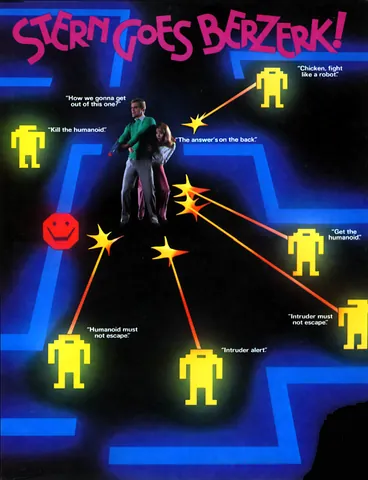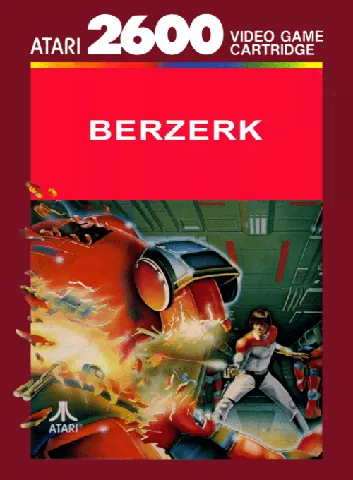
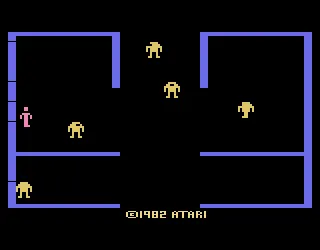
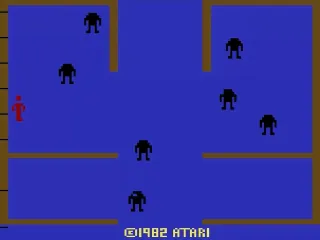
Enter a maze full of robots who want to kill you — and if you dally too long, an invincible smiley named Evil Otto comes rushing at you. Berzerk by Stern from 1980 was one of the most stylish and at the same time most merciless shooters of the early arcade age.
The player controls a human character trapped in a series of connected rooms full of moving robots. The goal is to shoot them or sneak past them to the exit, but touching a live wall, an enemy's shot or a robot itself means instant death. The robots also shoot back and grow ever more aggressive. And whenever you linger, Evil Otto appears — a bouncing face that cannot be destroyed and that relentlessly pursues you to drive you onward.
Berzerk went down in history as one of the first games that could speak. Thanks to a voice synthesizer the robots uttered lines like "Intruder alert!" or taunts aimed at the player — for 1980 it was a stunning effect that drew crowds in the arcades. This digitized speech was expensive and technically demanding for its time, which made the impression all the greater.
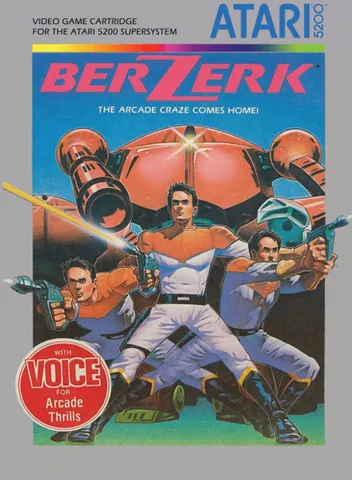
The home port on the Atari 2600 carried over the basic tension of the labyrinth and the merciless pace, albeit without the voice accompaniment, which the console's hardware couldn't handle reasonably. Even so it stayed faithful to the atmosphere of panic and flight that made the original such an unforgettable experience.
Berzerk also became the subject of a dark gaming folklore legend about alleged cases where players collapsed at the machine — a story that only added to its reputation as one of the toughest games of its time. Its influence on the run-and-shoot-in-mazes genre is undeniable.
Why play: A merciless maze shooter with a historical first in talking robots — an adrenaline-fueled escape where every hesitation means an encounter with the invincible Evil Otto.
Game 18 of 69 for Atari 2600
The same title elsewhere (3)
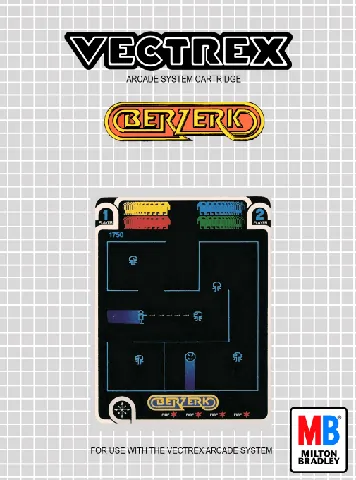
Stern's arcade original was famous for its digitized robot voices and vector graphics, and that's exactly what sets the home conversions apart. The GCE Vectrex version ran on its own vector display, so it kept the sharp, glowing lines close to the arcade look, albeit without the voice work. The Atari 2600 version had to replace the vector graphics with cruder raster drawing, fewer details, and simplified robots, and the sound was also noticeably more limited. Anyone wanting the experience closest to the arcade cabinet should pick the Vectrex; the Atari 2600 offers a simplified but still playable alternative.