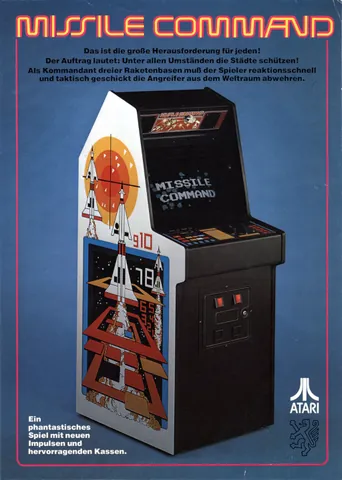
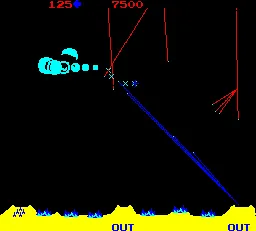
Missile Command is one of the most oppressive games Atari ever released — and its tension springs directly from the Cold War paranoia of 1980. With a trackball you aim a cursor across the sky and launch counter-missiles to intercept a rain of ballistic missiles hurtling toward six cities at the bottom of the screen. It's not a game about winning. It's a game about how long you can delay the inevitable end.
The game design is masterful in its cruelty. You have three batteries with a limited supply of missiles and must anticipate the trajectories of enemy rockets, MIRV warheads, bombers, and satellites. Each counter-missile explodes into a circle that has to catch as many of them at once as possible — so you're playing a game of timing and space. As the levels pile up, the sky fills and the decision of which city to sacrifice becomes chillingly personal. The famous ending "THE END" instead of the usual "GAME OVER" still sends shivers down players' spines.
The retro community reveres Missile Command as a rare case where an arcade game carries a real message. Its author, Dave Theurer, reportedly had nightmares about nuclear war because of the game. That atmosphere of helplessness, where you know you'll always lose in the end and it's only a matter of losing more slowly, makes it one of the most powerful experiences of the golden age of arcades.
Game 76 of 258 for Arcade
The same title elsewhere (3)
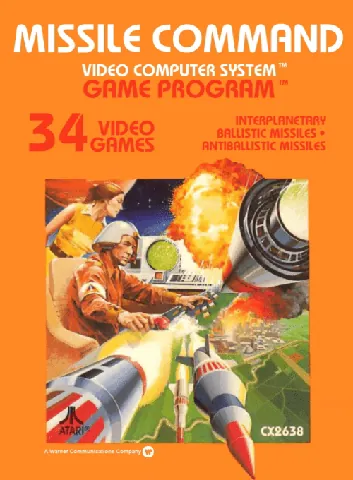
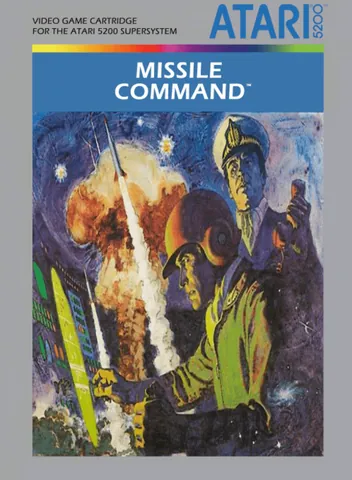
The 1980 arcade original was controlled with a precise trackball that let players sweep and fine-aim across the whole screen in an instant — which is why it's still regarded as the smoothest and best-looking version. The Atari 2600 port had to replace the trackball with a joystick, making aiming noticeably slower and coarser, and the graphics lost color and detail due to the console's weaker hardware. The Atari 5200, on the other hand, offered an analog controller whose range came much closer to the trackball, so its controls felt far closer to the arcade original than the 2600's did, and many players rank it among the best home ports ever, even though its colors and smoothness still fall short of the arcade.