Missile Command
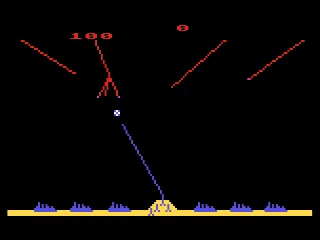
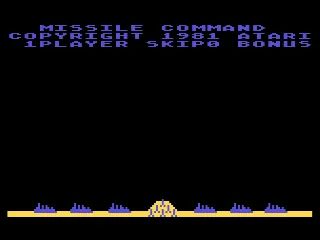
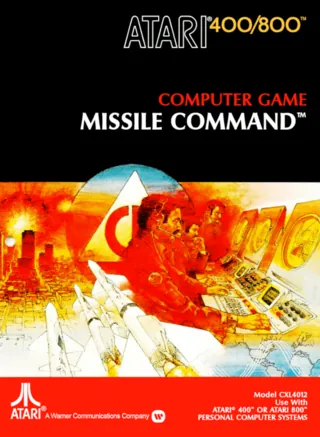
Missile Command brought the famous arcade original to the Atari 800, in which the player defends six cities from a relentless barrage of ballistic missiles. Trackball control was essential on the original arcade machine; on the home computer it was replaced by a joystick together with a crosshair cursor that the player uses to aim at the sky and launch counter-missiles from three bases. Each base has a limited supply of ammunition, so the player must carefully choose which missile to shoot down and when to instead risk letting it land, because supplies run out quickly and the waves of attacks speed up as the game progresses.
The game works with simple but functional graphics, where missile explosions create characteristic circular blast zones that destroy everything within reach, including other enemy missiles. Faster missiles and bombers gradually appear, raising the demands on real-time decision-making. The atmosphere is rounded out by a sparse but nerve-wracking soundtrack and the final automatic destruction of unprotected cities if the player loses all bases, which also made the game famous as one of the first with a markedly pessimistic, hopeless tone.
On the 8-bit Atari, it was one of the titles that demonstrated well how capable hardware could handle arcade action full of simultaneously moving objects. Missile Command became an icon of the defensive shooter genre, and its influence is visible in many later titles based on the principle of gradually escalating attacks and limited resources. Even decades later it remains playable, and the tension from dwindling ammunition and increasing pace works just as well as at its original release. The game is also often mentioned outside a purely gaming context as one of the first popular titles whose hopeless ending, where the destruction of the cities is ultimately unavoidable, brought an unusually heavy social undertone into arcade entertainment, rooted in period fears of nuclear conflict.
Why play it: For fans of tense defense with dwindling ammunition and rising tempo, Missile Command remains a playable genre icon with an unusually heavy undertone of inevitable destruction.
Game 102 of 124 for Atari 800 / 8-bit
The same title elsewhere (3)
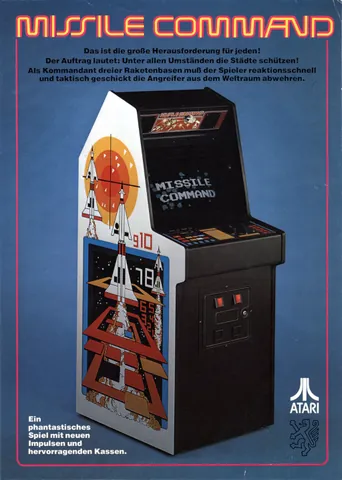
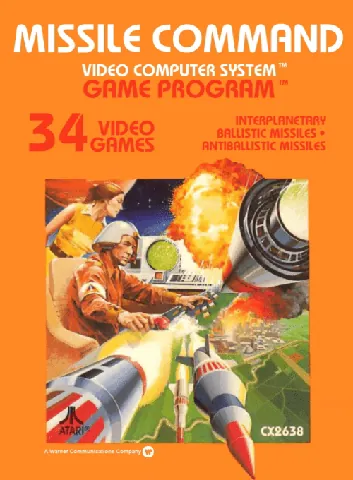
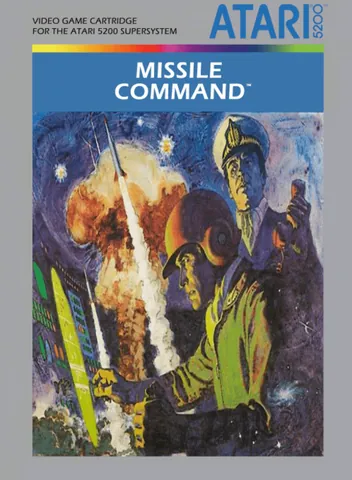
The 1980 arcade original was controlled with a precise trackball that let players sweep and fine-aim across the whole screen in an instant — which is why it's still regarded as the smoothest and best-looking version. The Atari 2600 port had to replace the trackball with a joystick, making aiming noticeably slower and coarser, and the graphics lost color and detail due to the console's weaker hardware. The Atari 5200, on the other hand, offered an analog controller whose range came much closer to the trackball, so its controls felt far closer to the arcade original than the 2600's did, and many players rank it among the best home ports ever, even though its colors and smoothness still fall short of the arcade.