Dig Dug
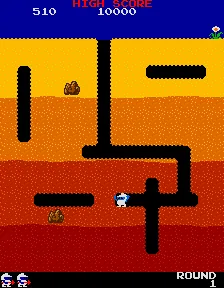
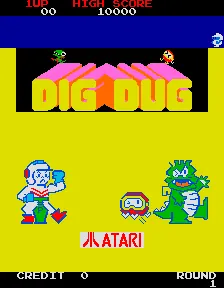
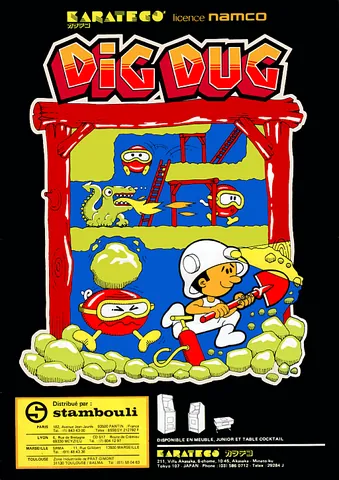
Sometimes the best weapon is an ordinary pump. Dig Dug, which Namco unleashed into arcades in 1982, built its entire gameplay on an idea so bizarre it is brilliant: here you eliminate enemies by inflating them with air until they burst like a balloon.
The player controls a miner named Dig Dug, who digs through the underground and carves tunnels in the dirt at will. The goal is to destroy all the monsters - the dragon-like Pookas and the goggled, fire-breathing Fygars. Besides the inflating harpoon, the player also has a second tactic at hand: undermining boulders so they fall and crush the enemies beneath. This turns a simple chase into a little strategy game about shaping the maze, luring enemies into traps, and managing risk, because a Fygar can hit you with its flame even across a tunnel.
Behind the game stands Namco during its golden era, when it churned out one hit after another. Dig Dug was created only shortly after the studio conquered the world with Pac-Man, and it shares with it the same playful, accessible philosophy - simple rules, easy controls, but room for mastery. Key Namco creators of the era contributed to the music and design, and the result was another worldwide commercial success.
Culturally, Dig Dug joined the ranks of the most popular maze arcades of the eighties and became a permanent part of Namco's portfolio. It received a direct sequel, Dig Dug II, a range of ports to home consoles and computers, and it regularly appears in retro compilations and official re-editions. The character of Dig Dug, whose real name is Taizo Hori, also appears in other Namco titles, and the game inspired later digging variations like Mr. Driller, where he figures as Hori's son.
At first glance Dig Dug looks cute and innocent, but it hides a surprisingly deep competitive dimension. The chase for a high score, optimizing the order of enemy elimination, and the clever use of falling boulders make it a title that players return to this day.
Why play it: For the original idea of inflating enemies and for the unexpected strategic depth - one of the most likeable gems of the golden era of arcades.
Game 31 of 258 for Arcade
The same title elsewhere (4)
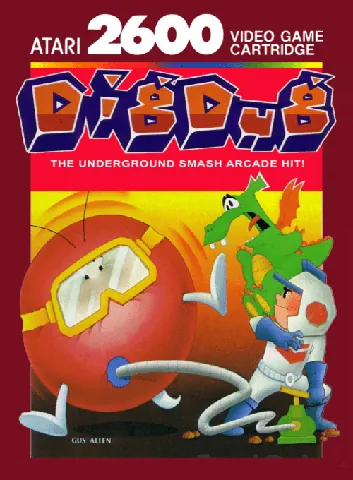
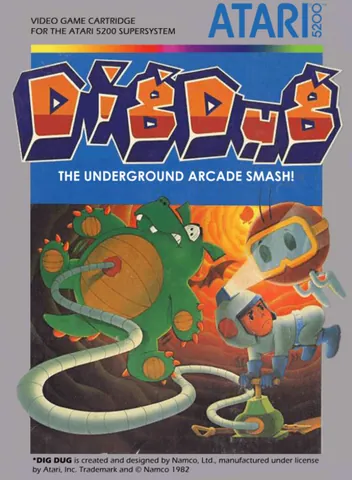
The arcade cabinet relied on bold, saturated colors and smooth animation for Dig Dug and his enemies, something home conversions struggled to match. The Atari 2600, limited by its hardware, had to settle for simplified graphics, a narrower color palette and blockier animation, so the pace and feel of tunneling come across noticeably stiffer than in the arcades. The Atari 5200 had more capable chips than the 2600, and its version offered richer colors and smoother movement, closer to the arcade original. Anyone after the truest experience should pick the arcade version, while the Atari 5200 stands as the sturdier home alternative compared to the older 2600.