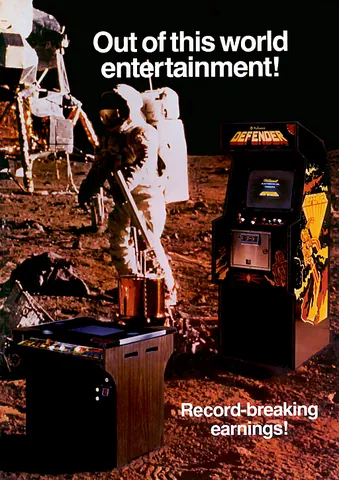
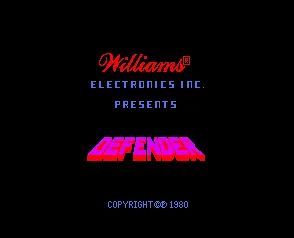
Few cabinets could crush a player right from the first coin quite like Defender. This punishingly hard shooter from America's Williams Electronics, released in 1981, earned a reputation as a game that would swallow your quarter before you even grasped what was happening on screen - and yet it became one of the biggest hits of the golden era.
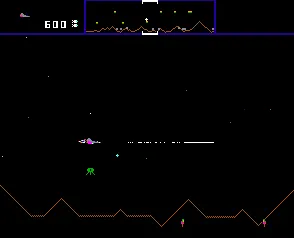
Unlike most shmups of the time, Defender unfolded across a horizontally scrolling world far wider than the screen itself. The player pilots a spacecraft above a planet's surface with a twofold mission: destroy waves of alien attackers while protecting human colonists whom the invaders are trying to abduct and turn into mutants. If an abductor reaches the top edge, a deadly mutant is born. The controls were extraordinarily complex for their day - beyond firing and thrusting forward, the player also had reverse, a hyperspace jump, and devastating smart bombs. A radar strip at the top of the screen helped you navigate the sprawling world, a feature taken for granted today but pioneering back then.
Behind the game stood designer Eugene Jarvis, who wasn't afraid to step outside the comfort of simple concepts. Defender was Williams' first video game, and its development was dogged by doubts - many considered it too complicated. Its debut at the 1980 AMOA trade show was lukewarm, but once the cabinets reached the arcades, it turned out that the brutal difficulty was precisely the magnet. The game became an enormous commercial success and earned hundreds of millions of dollars.
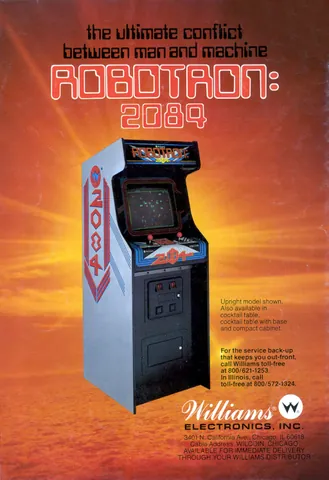
Culturally, Defender defined the subgenre of horizontal shooters built around protection and two-way movement, and it inspired countless followers. Its radar, smart bombs, and protective mechanics became recurring staples of the genre. Williams built on the success with the sequel Stargate (later Defender II), and Jarvis himself went down in history with another legendary title, Robotron: 2084.
To this day, Defender stands as a test of true arcade mastery - its uncompromising difficulty separates the casual player from the fanatic, and a high score here is a matter of well-earned pride.
Why play: For the unfiltered adrenaline of a merciless arcade, and for the feeling that you're playing a piece of history that set the difficulty bar for an entire genre.
Game 33 of 258 for Arcade
The same title elsewhere (2)
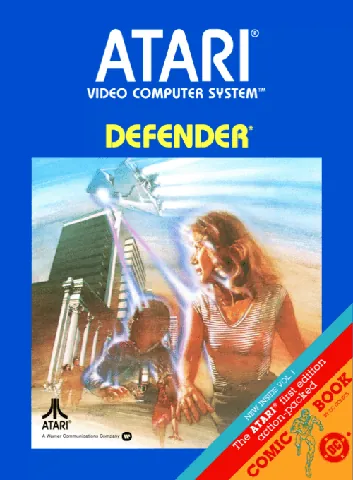
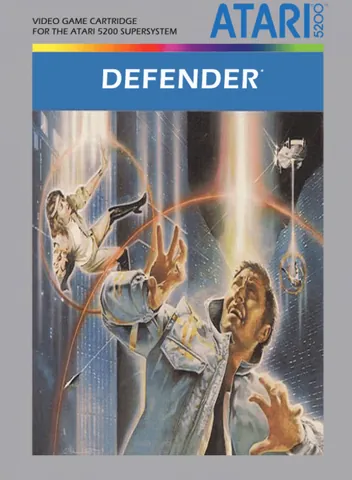
The Williams arcade original ran on its own vector-based graphics hardware, giving smooth, fast movement and a full set of controls — thrust, reverse, fire, smart bombs and hyperspace — that rewarded precise hand-eye coordination. The Atari 5200 port tried to preserve that control scheme but relied on the console's analog joystick, notorious for imprecision and wear, which made fine ship handling noticeably harder in a game built around exactly that. Graphics and sound had to be scaled down to home 8-bit hardware, so scrolling feels less smooth and the audio thinner than on the arcade board. If you want Defender at its best, the arcade version is the one to pick.