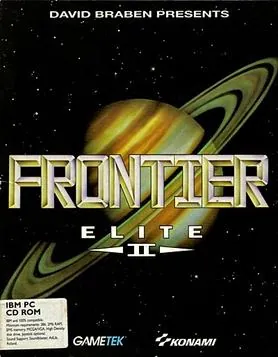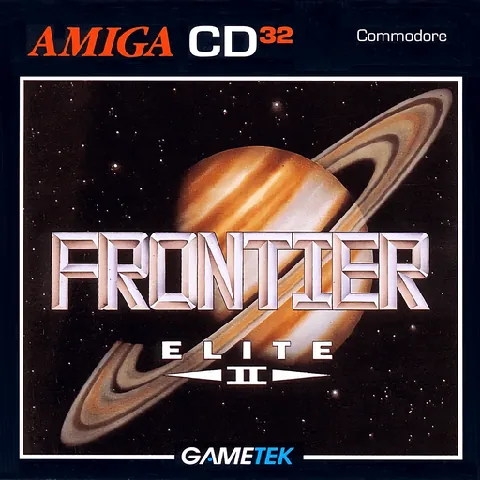
Frontier: Elite II
You sit in the cockpit, before you spreads a galaxy of billions of stars and no one is telling you what to do. Frontier: Elite II on the Commodore Amiga is space freedom in its purest form, a sequel to the legendary Elite that pushed the boundaries of what a player at a computer could imagine at the time.
From the pen of David Braben, one of the two authors of the original Elite, came a game of unprecedented ambition. Instead of a stylized wireframe universe, you have here a vast galaxy with realistic Newtonian flight physics, planets that can be landed on, orbits and systems modeled with regard to actual astronomy. The ship does not turn like a fighter in the atmosphere but behaves according to inertia, so maneuvering, docking and combat all require a genuine understanding of motion in space. This fidelity to physical laws was absolutely exceptional for its time.
The gameplay is open to the extent that you set the goals yourself. You can trade goods between systems and follow supply and demand, hunt wanted pirates for a bounty, smuggle illegal cargo, take on missions, mine, or simply explore. Gradually you earn your way to better ships and equipment and decide for yourself whether you will be an honest merchant, a ruthless mercenary or an outlaw on the run from the law. Freedom of choice is absolute here, and it is precisely this that makes Frontier an experience that is different for every player.
In the development context of the early nineties it was a technical marvel. Cramming an entire galaxy and realistic physics into the memory of the computers of the time, including the Amiga, was a masterstroke, and Frontier became a symbol of an ambitious, almost endless game world generated procedurally. It built on the cult status of the original Elite, which is still considered one of the most influential games in history and a pioneer of open worlds and space trading.
The influence of this series is immense. Frontier: Elite II deepened the idea that a game does not need a fixed story or a clear ending to work, and inspired generations of space simulators and sandbox titles. For many players it was the first encounter with the feeling of true freedom among the stars, where the only limit was their own imagination and the contents of the fuel tank.
On the Amiga, Frontier was among the titles that showed everything this machine could handle. The smooth polygonal rendering of space, planets and ships together with the extensive simulation core seemed like a small miracle for its time and reinforced the reputation of the Amiga as a machine for demanding games. The controls were at first a little off-putting and the learning curve steep, but players who persevered were rewarded with an experience that no other game of the era offered them. It was precisely this depth that made Frontier a title to which enthusiasts return to this day.
Why play: For the intoxicating feeling of absolute freedom in a realistically conceived galaxy, where it is just you, your ship and infinite possibilities.
Game 46 of 121 for Commodore Amiga
The same title elsewhere (1)
Frontier: Elite II is extremely demanding on processing power, since it calculates the entire galaxy and every ship in real time using software-rendered 3D — and that shows in the difference between platforms. On a standard Commodore Amiga with its base 68000 processor the game visibly slows down, especially in the filled-polygon graphics of cities and stations, so many players switched to the simpler wireframe view just to keep things smooth. The PC/DOS version, run on a faster 486, handled even the filled graphics considerably more smoothly and offered a sharper VGA picture. Anyone wanting to explore the galaxy without stutter should reach for the PC version today.