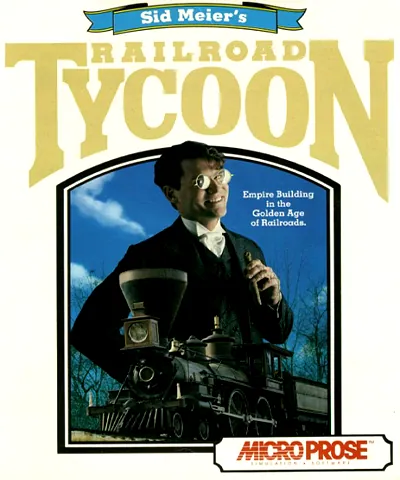
Railroad Tycoon
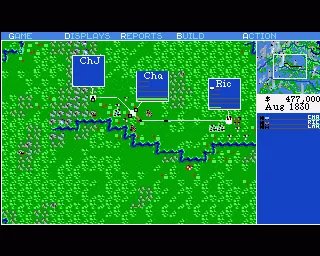
You lay the first rail between two cities, send a locomotive onto it and suddenly you hold in your hands the fate of an entire developing country crisscrossed by steel arteries. Railroad Tycoon on the Commodore Amiga is an economic strategy in which you build a railway empire and balance between engineering, commerce and hard business.
The game combines two levels that interweave with each other. On one side you plan and build the railway itself, run tracks through the landscape, deal with gradients and terrain, build stations, depots and signaling and put together timetables of trains that carry passengers as well as cargo like coal, goods or mail between cities. On the other side you play an economic game: you invest in stocks, run the company, fight with competing railways and try to build the most profitable and influential transport network possible. The connection of logistics and finance gives the game unexpected depth.
The magic of Railroad Tycoon lies in how meaningfully everything fits together. When you connect the right cities with the right commodity, the economy flourishes, cities grow and your company prospers. A poorly run track, neglected competition or an unfortunate investment, on the other hand, can bring you to your knees. The player thus constantly weighs dozens of variables and every decision has long-term consequences, which makes the title an addictive challenge for entire evenings.
In the development context it was the work of the legendary designer Sid Meier at the studio MicroProse and one of the foundational games that defined the genre of economic tycoon strategies. Railroad Tycoon showed that building and management can be just as gripping as action or adventure, and became a direct inspiration for a whole later wave of building and management games. Meier's signature, that is, unobtrusive depth and the legendary just one more turn, can be felt at every step.
The influence of this game is still evident today. Railroad Tycoon is regularly ranked among the key strategy titles of its era and gave rise to a whole series of sequels that further developed the idea of building railways. For many players it was the first contact with how satisfying it can be to watch an empty map gradually become a prosperous country crisscrossed by trains, built purely by their decisions.
On the Amiga, Railroad Tycoon retained all of its strategic depth and offered it to an audience that had a soft spot for similarly thought-out games. Mouse control suited both the planning of tracks and the management of offers and tables, so players could immerse themselves in the role of a railway magnate without compromise. Moreover, the game had no shortage of long-term playability, because every map and every era of railway development brought new challenges and possibilities for how to build an empire differently. It was precisely this inexhaustibility that made it one of the titles to which players returned again and again.
Why play: For the deep and addictive combination of railway building and economic strategy from the workshop of the master of the genre, Sid Meier.
Game 48 of 121 for Commodore Amiga