La Abadía del Crimen
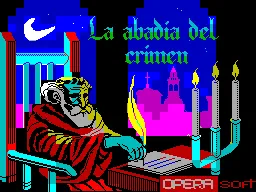
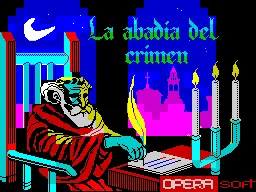
There are games that technically defy everything anyone considered possible on a given platform — and La Abadía del Crimen is exactly such a case. This Spanish adventure, loosely inspired by Umberto Eco's novel The Name of the Rose, is a legend not only on the Iberian Peninsula.
The player steps into the shoes of the monk William of Occam (an analogue of William of Baskerville), who investigates a series of murders in a gloomy medieval monastery. The game combines an adventure with elements of simulation — you must keep to the monastery schedule, attend services and meals, move in real time and keep an eye on your assistant Adso. The monastery is rendered in an impressive isometric perspective with smooth character movement, which felt almost miraculous on eight-bit hardware.
Behind the game stands the Spanish developer Paco Menéndez together with the graphic artist Juana Ortega; the title was released in 1987. It was originally meant to be named directly after Eco's novel, but due to unresolved rights it received the name La Abadía del Crimen. To this day it is considered one of the technical and artistic peaks of the entire Spanish gaming scene, the so-called Edad de Oro del software español.
For its time it was an extraordinarily ambitious design: the game punished the player for failing to keep the order, demanded observation and deduction, and told a real story with atmosphere. This combination of environmental simulation and detective plot was years ahead of its time.
La Abadía del Crimen earned a reputation as a cult work and has seen modern remakes and translations, thanks to which players outside the Spanish-speaking world can discover it too. For connoisseurs of European gaming history it is an unmissable milestone.
Why play it: For a detective adventure exceptional in both technique and atmosphere, one of the peaks of the Spanish eight-bit era.
Game 24 of 100 for ZX Spectrum