Elite
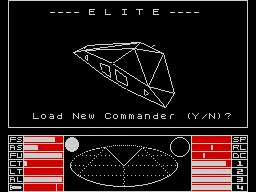
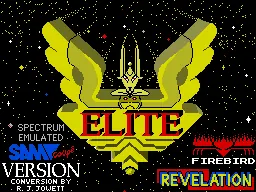
An entire galaxy, thousands of planets, trade, piracy and deadly duels in space - and all of this fit into just a few kilobytes of an eight-bit computer. Elite was a revelation in the mid-eighties that was decades ahead of its time, and its conversion to the ZX Spectrum in 1985 ranks among the platform's technical miracles.
The duo David Braben and Ian Bell created, under the Firebird label, a game with no fixed story and no ending in the traditional sense. You sit in the cockpit of a Cobra Mk III ship, start out with a few credits, and what you do with it is entirely up to you: trade goods between planets, mine asteroids, take on contracts, or set out on the path of a pirate and raid others. This openness was utterly unprecedented for its time.
The technical heart of the game was its vector three-dimensional ship models, rendered in wireframe graphics in real time. Station docks, combat maneuvers and docking sequences felt like something from another world compared to the usual platform fare. The brilliant trick was that the enormous game universe with its many galaxies and hundreds of planets was not stored in memory but procedurally computed from a small seed - otherwise it would never have fit into the computer.
Progress was measured by a system of ranks, from the starting „Harmless“ up to the coveted goal after which the game is named - to become a true Elite required hundreds of enemies shot down and hours spent in the cockpit. This long-term motivation, combined with freedom of choice, defined the entire genre of space simulators and trading sagas for decades to come.
Elite's influence is hard to overstate: it stood at the birth of open-world games and the space trading genre, inspired countless followers and, years later, received a grand return in the form of the modern sequel Elite Dangerous. Meanwhile, the Spectrum version remains proof of how far one could go even on seemingly modest hardware.
Why play it: For the feeling of utter freedom in your own spaceship and for an encounter with a game that single-handedly invented both the open world and space trading.
Game 19 of 100 for ZX Spectrum
The same title elsewhere (3)
This space legend originated on the BBC Micro with purely wireframe 3D ship graphics, and the home 8-bit ports handled that legacy differently. The Commodore 64 version gave ships filled, colored surfaces instead of plain outlines, making combat and docking look clearer and visually richer. The ZX Spectrum version stayed closer to the original wireframe style due to its more limited speed and memory, though the trading and combat systems are identical on both machines. Anyone wanting nicer, clearer 3D should pick the C64; fans of the stark wireframe look will prefer the Spectrum.