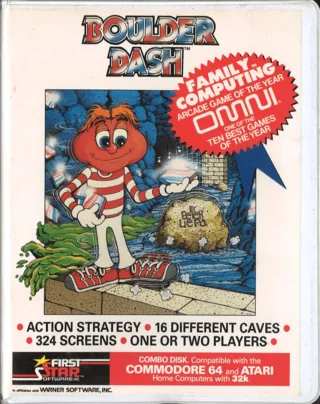
Boulder Dash
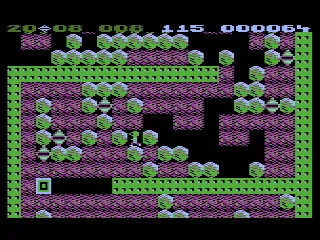
A falling boulder that crushes you in the last hundredth of a second because you dug one tile too many beneath it — that's Boulder Dash in a single moment. This game from 1984 managed to turn the simple idea of "dig in the ground and collect gems" into one of the most elegant puzzle systems of the eight-bit era. And on the Atari 800, where it was born, it looks and plays with total confidence.
The core of everything is physics. The hero Rockford digs through soil in sprawling caves and collects diamonds to open the exit to the next level. The catch is that boulders and gems are subject to gravity: as soon as you dig empty space beneath them, they start to fall. A rock that falls on your head means death — but you can cleverly use that same rock to crush an enemy or clear a path. Each cave is thus both a spatial puzzle and a game against time, because the limit forces you to choose a route quickly and completely.
Boulder Dash was designed by Peter Liepa and Chris Gray and published by First Star Software. They hit on something timeless: the rules are trivially easy to grasp, but the room for ingenious level layouts is practically endless. The game combines the calm of thoughtful planning with panicked moments when the entire cave starts collapsing and you run for the exit through an avalanche of rock.
The cultural footprint of this game is enormous. The falling-rock mechanic became a genre of its own and was cloned countless times and officially ported across virtually every platform of the day, from home computers to consoles and later mobiles. For many players of the eight-bit era, Boulder Dash ranks among the titles that defined what "puzzle action" actually means.
On the Atari 8-bit, Boulder Dash is a home classic in the best sense — smooth scrolling, readable cave graphics, and an instantly addictive "just one more cave" loop. It's one of those games that, after forty years, makes you realize anew just how little it takes for perfect design.
Why play: A textbook example of timeless game design, where simple rules give rise to deep puzzles and panic at the same time.
Game 10 of 124 for Atari 800 / 8-bit
The same title elsewhere (3)
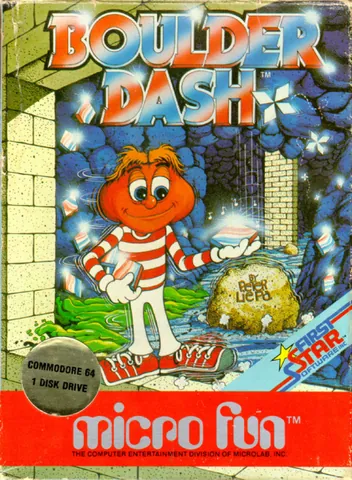
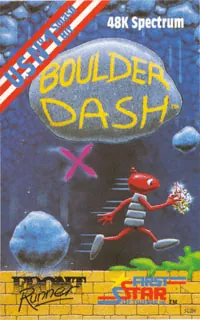
Boulder Dash launched simultaneously on Atari 8-bit and Commodore 64 in 1984, and both versions still rank among the best-regarded – Atari benefited from smooth hardware scrolling and snappy response, while the C64 offered bolder colours and the SID chip gave it a distinctive score. On the ZX Spectrum, development hit the machine's classic limitation: attribute clash meant each tile could only carry a restricted colour combination next to its neighbours, making the playfield flatter and less colourful than on the Commodore. The Amstrad CPC sits closer to the C64 colour-wise, though its processor gives the game a slightly different pace. The core loop stays the same everywhere, just dressed differently.