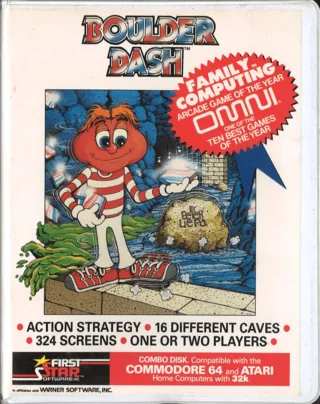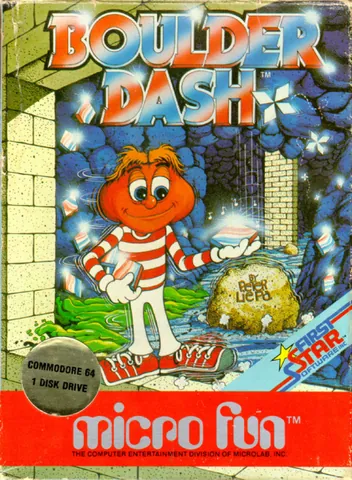
Boulder Dash
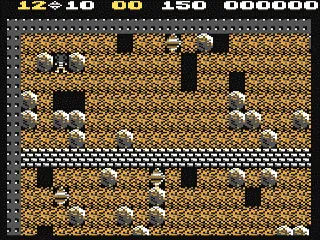
One boulder comes loose, thunders downward — and you have a fraction of a second not to be underneath it. Boulder Dash is one of those puzzle games that look simple until your own greed crushes you for the first time. On the Commodore 64 it's just as immortal as on its home Atari.
The concept is ingeniously simple: you dig your way through the dirt in a cave, collect diamonds, and search for the path to the exit. The catch is gravity — boulders and diamonds fall the moment you dig out the space beneath them, and a badly timed move means death under the rocks or getting stuck in a trap you set for yourself. Each level is thus a small spatial puzzle where you have to think ahead and watch how the surroundings collapse after each of your steps.
Boulder Dash was created in 1984 at First Star Software and quickly became one of the most influential puzzle titles of the 8-bit era. Its mechanic of falling objects and digging became a model for a whole host of later games and clones. On the Commodore 64 it found an ideal home — a platform with a large player base spread its fame across the whole world.
Culturally, Boulder Dash is proof that the best game ideas rest on one clear, clean rule. Just as with the other classics of this time, the whole magic lies in the fact that you grasp the principle within seconds, but mastering it takes you hours. This balance of accessibility and depth is why players return to it to this day.
The difficulty rises mercilessly and later levels demand precise planning as well as quick fingers. But that's exactly where the right puzzle flavor lies — Boulder Dash doesn't punish stupidity, but inattention.
Why play: A pure, timeless puzzle game where one wrong step means a boulder on the head — easy to grasp, devilish to master.
Game 3 of 121 for Commodore 64
The same title elsewhere (3)
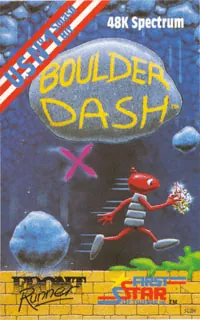
Boulder Dash launched simultaneously on Atari 8-bit and Commodore 64 in 1984, and both versions still rank among the best-regarded – Atari benefited from smooth hardware scrolling and snappy response, while the C64 offered bolder colours and the SID chip gave it a distinctive score. On the ZX Spectrum, development hit the machine's classic limitation: attribute clash meant each tile could only carry a restricted colour combination next to its neighbours, making the playfield flatter and less colourful than on the Commodore. The Amstrad CPC sits closer to the C64 colour-wise, though its processor gives the game a slightly different pace. The core loop stays the same everywhere, just dressed differently.