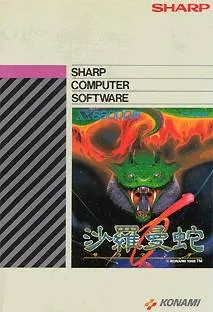
Salamander is a side branch of the Gradius series that differs from the main line in several fundamental ways, and it received a conversion on the Sharp X68000 that matched the demands of contemporary fans. Above all, it alternates between horizontally and vertically scrolling stages, so the player moves from a classic rightward flight into vertical sections above a planet's surface and back again. The second major change is the upgrade system: instead of a gauge that needs to be charged, the player collects specific icons that immediately grant speed, a missile, laser or a satellite. This makes the game more accessible while also making it fiercer, since after dying the loadout can be recovered faster than in Gradius. There's also a full two-player simultaneous mode, which makes it an ideal title for a shared evening.
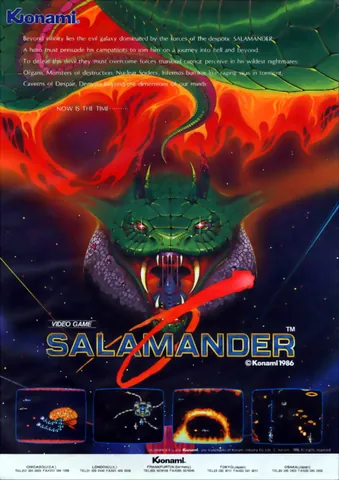
Visually, Salamander is famous for its organic, biological design, where pulsating tissue, fiery protuberances and giant creatures made of flesh and metal wind between metallic structures. The X68000 handles this aesthetic with colors that suit it well and maintains smoothness even when the screen fills with projectiles. The FM synthesis soundtrack is fast, rhythmic and driving, complemented by sampled effects, and together with the darker visual tone it creates the atmosphere of a journey into the guts of something living and hostile. Even today, it remains one of the most distinctive audiovisual identities in the genre.
At the time, this conversion was a respected entry in the X68000 catalog, though it stood in the shadow of the more famous Gradius II. Salamander's influence on the genre lies mainly in mixing horizontal and vertical sections and in its emphasis on two-player cooperation, which was a bold move at a time when most shooters assumed only a single pilot. Today the game feels brisk and readable, its difficulty somewhat friendlier than its sister series, and cooperative play gives it an energy the single-player mode lacks. For anyone who loves classic shooters, it's a very pleasant hour spent in the fiery guts of a space monster.
Game 7 of 25 for Sharp X68000
The same title elsewhere (2)
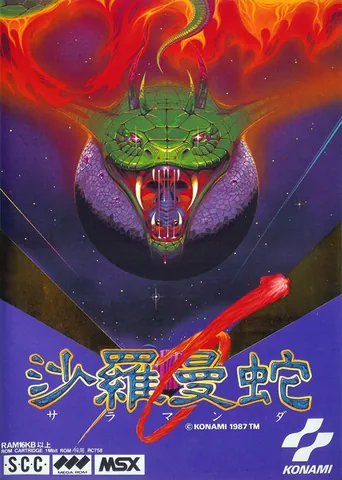
The Konami arcade version ran on its own sound and graphics board, handling smooth transitions between horizontal and vertical sections and simultaneous two-player action without slowdown, with music carrying a full, layered sound from dedicated hardware. The MSX port had to work with the home computer's considerably weaker graphics chip, so scrolling looks blockier and the color palette narrower, while the music sounds thinner since the MSX sound circuit has fewer channels than the arcade board. Konami knew the MSX well and treated it almost like a second home platform, so they tried to preserve gameplay as faithfully as possible despite the visual compromises. The arcade rendition remains the smoothest and richest-sounding version of the game.