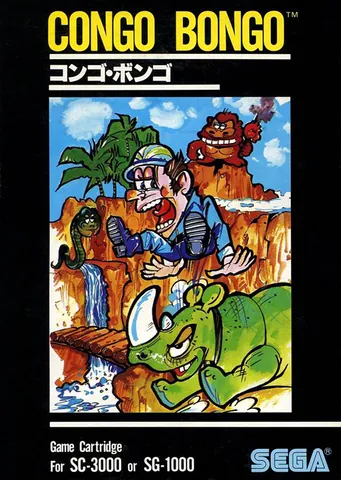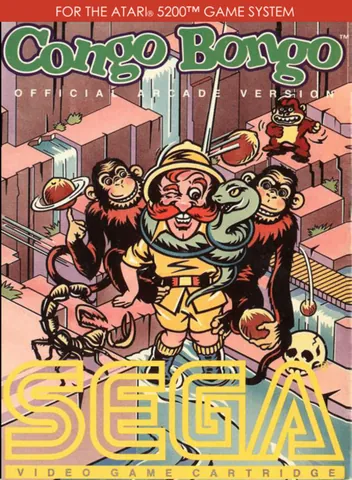
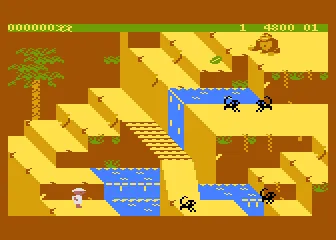
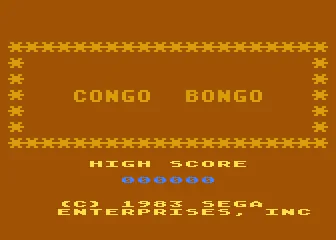
Congo Bongo is an arcade platformer from Sega, which the company itself ported to the Atari 5200 as part of its then-cooperation with Atari on home ports of its own arcade titles. The game loosely follows the genre template established by Donkey Kong, but offers an isometric view of a scenery in which the player, as an adventurer, climbs rocks, jumps over chasms, and dodges coconuts, stones, and other hazards on the way to a monkey named Congo, with later scenes introducing water obstacles with hippos and other animals attacking from various distances. The isometric presentation gave the game unusual visual depth at the time of release and clearly set it apart from the flatter platformers of its contemporary competition, though it also made it harder for both viewer and player to judge distances precisely.
The Atari 5200 port tried to preserve the visual style of the arcade original, including its layered jungle, waterfall, and cave scenes, and although the color palette and level of detail had to be simplified compared to the arcade board due to the 8-bit console's hardware limitations, the basic atmosphere of exotic adventure remains well conveyed. Analog-stick control took some getting used to because of the isometric perspective, which makes it hard to judge the character's exact position relative to platform edges and chasm rims, leading to frequent, frustrating falls for inexperienced players. Contemporary reception was mixed to positive, with Congo Bongo valued more for its originality and fresh take on the genre than for flawless technical execution or perfect controls.
Today, Congo Bongo represents an interesting departure from the standard platformer formula of its time thanks to its isometric graphics, which later influenced further perspective experiments within the platformer genre and other action games. On the Atari 5200, it's a solid, though unusually demanding, conversion due to its specific controls and unusual perspective, appreciated mainly by collectors and fans of the early 1980s arcade aesthetic.
Why play it: For its unusual isometric perspective, which influenced later platformers, though the demanding controls will appeal mostly to collectors and fans of early arcade aesthetics.
Game 18 of 41 for Atari 5200