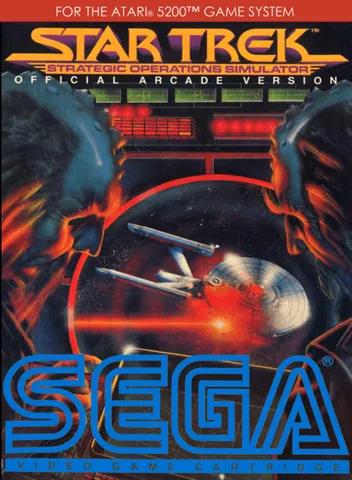
Star Trek: Strategic Operations Simulator
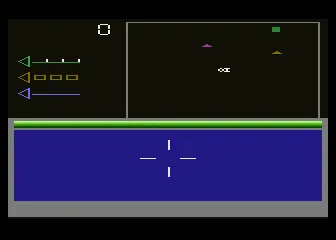
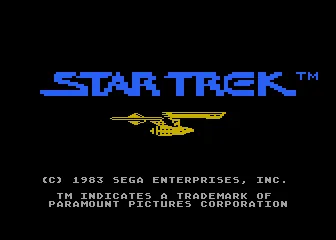
Star Trek: Strategic Operations Simulator puts the player in the captain's chair of the USS Enterprise, commanding the crew in defense of a galactic sector against a Klingon invasion. The game combines a bridge view, from which the player uses phasers and photon torpedoes to destroy enemy ships displayed on a long screen simulating the ship's sensors, with a tactical sector map for planning movement between quadrants and deploying Federation bases. The game also includes a ground mission, in which the player commands a landing party on a planet's surface and defends it against attacking Klingons using hand phasers.
On the Atari 5200, the game uses the joystick for both aiming and moving the ship, which feels clumsy compared to later controllers, but at the time represented a thoughtful attempt to bring a relatively complex simulation to a game console. The graphics are austere, made up of simple vector shapes and colored fields, and the sound is limited to sensor beeps and explosions, yet Atari's developers still managed to evoke the feeling of commanding a real starship under threat. The player must constantly monitor energy, shield, and weapon status and decide when to attack and when to evade, giving the game a hint of genuine resource management that was almost unheard of on game consoles in 1982.
The title was among the more ambitious efforts of the early Atari 5200 and drew on the popularity of the Star Trek series as well as the era's fondness for strategy games on computers, from which it borrowed the principle of moving between quadrants and planning long-term sector defense. The combination of space combat and ground tactics makes it one of the few titles on this console that approaches the adventure-simulation genre, while also showing how Atari, in the console's early years, tried to carry more complex game concepts from computers over to a simpler controller. Today it is more of a curiosity for fans of the genre's history than a playable experience in the true sense — the controls are slow and orientation within the sector is demanding — but as evidence of the effort to bring more complex game systems to a console, it has its place.
Why play it: For fans of the genre's history and the Star Trek series, who will appreciate an ambitious attempt at space and ground tactics, even though the slow controls make the game more of a curiosity than a playable experience.
Game 23 of 41 for Atari 5200
The same title elsewhere (4)
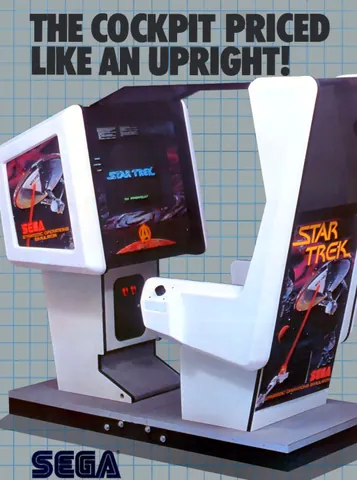
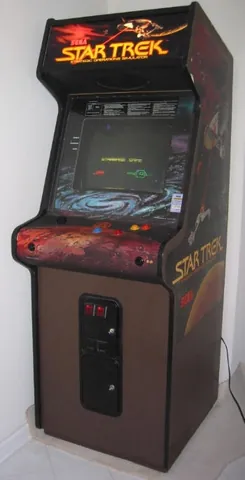
Sega's 1982 arcade original relied on vector graphics with coloured overlay film and a unique cockpit-shaped cabinet with a lever for selecting speed – an experience no home platform could literally reproduce. The conversions for the Atari 8-bit, ColecoVision and Commodore 64 therefore had to replace the vectors with simpler coloured raster shapes, sacrifice some sharpness in the starfield, and settle for an ordinary joystick or keyboard instead of the arcade cabinet's special controls. The differences between the home versions mainly come down to how much detail and smoothness each machine's power allowed – none of them quite matches the performance or atmosphere of the original arcade. Anyone wanting the true shape of the game should reach for an emulation of the arcade cabinet.
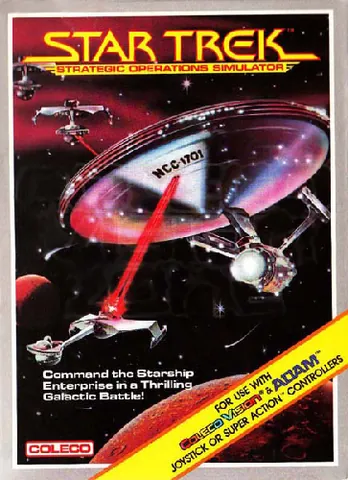
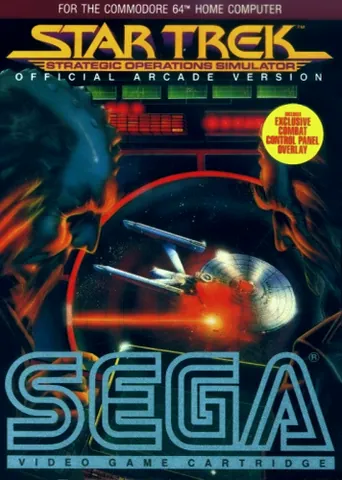
From the same series Star Trek →
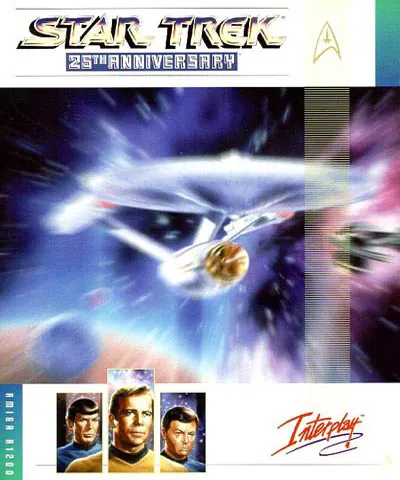 Star Trek: 25th Anniversary Amiga
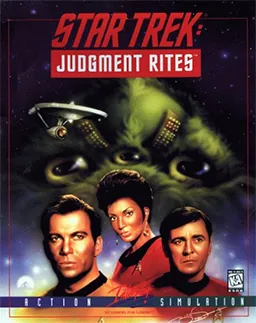 Star Trek: Judgment Rites Amiga
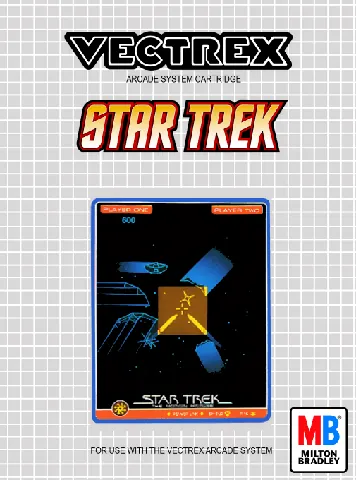 Star Trek: The Motion Picture Vectrex · 1982
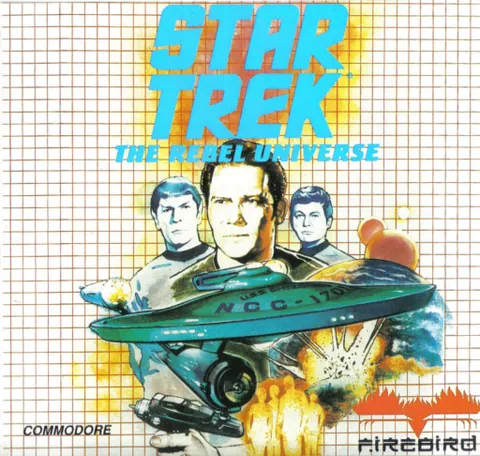 Star Trek: The Rebel Universe C64 · 1987
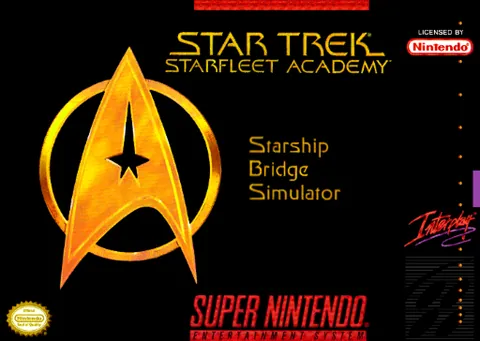 Star Trek: Starfleet Academy – Starship Bridge Simulator SNES · 1994
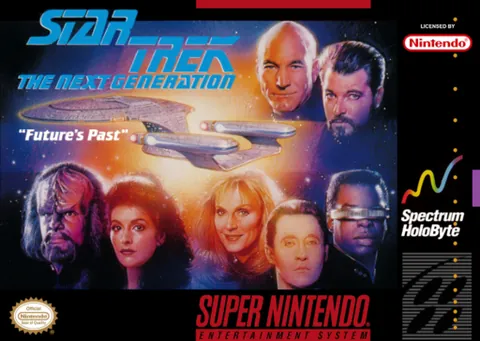 Star Trek: The Next Generation – Future's Past SNES · 1994
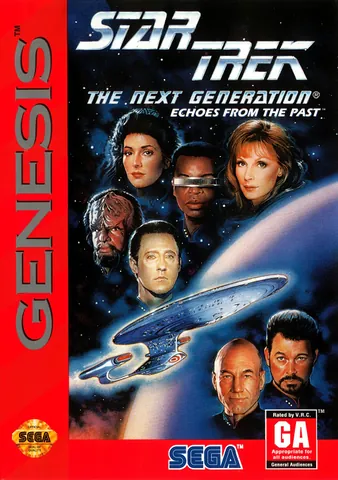 Star Trek: The Next Generation – Echoes from the Past MD · 1994
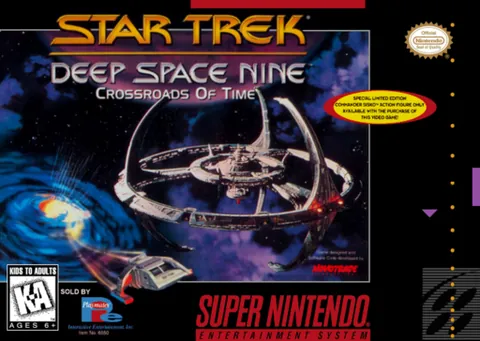 Star Trek: Deep Space Nine – Crossroads of Time SNES · MD · 1995
 Star Trek: Generations – Beyond the Nexus Saturn · 1997
 Star Trek: Starfleet Academy Win9x · 1997
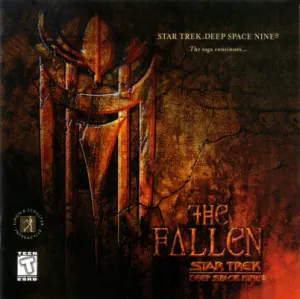 Star Trek: Deep Space Nine – The Fallen PS1 · 1999
 Star Trek: Starfleet Command Win9x · 1999