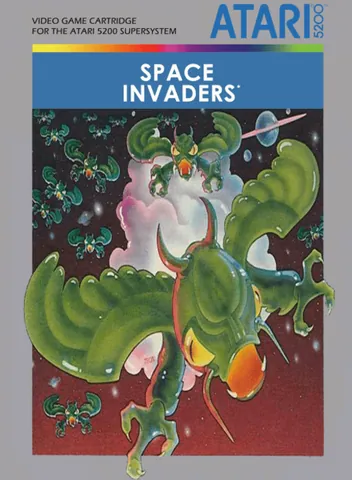
Space Invaders
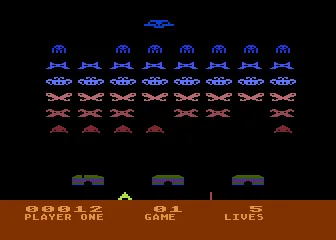
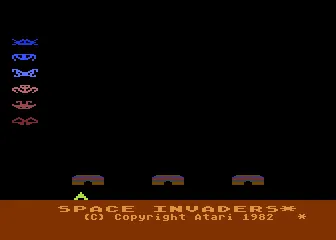
Space Invaders is one of the founding games of the entire video game industry, and on the Atari 5200 it was released by Atari itself, which at the time licensed the game from the Japanese company Taito and distributed it across its other platforms in North America as well. The player controls a laser cannon at the bottom of the screen and must gradually shoot down steadily advancing rows of alien invaders while hiding behind gradually eroding barriers from their retaliatory fire falling from above. The game's pace subtly accelerates as the number of enemies on screen decreases, creating rising tension up to the final wave of each level, when the remaining invaders are at their fastest and most dangerous.
On the Atari 5200, the game uses the analog stick for smooth sideways movement of the cannon, while a button handles firing, and although this control scheme differs slightly from the original arcade's sliding controller with fixed-track movement, the overall gameplay remains faithful to the original. The graphics match the capabilities of the 8-bit Atari hardware, and the characteristic pulsing sound of the invaders' marching footsteps, which speeds up as their numbers dwindle, was carried over to the console fairly faithfully. At the time of release, it was one of the key titles that helped define the early identity of the home video game market and of the Atari platform itself.
Space Invaders' influence on the shooter genre is undeniable, and the game is still cited today as one of the main reasons for the mass spread of arcade machines and home consoles worldwide in the late 1970s and early 1980s. The Atari 5200 version offers a solid, though even at the time of release not entirely groundbreaking, experience given the many other available ports, valuable above all as a historical milestone of the entire genre and as a reminder of its very origins in arcades.
Why play it: To understand the historical roots of the entire shooter genre and its journey from arcade machines into living rooms, even though the experience itself no longer holds many surprises today.
Game 17 of 41 for Atari 5200
The same title elsewhere (2)
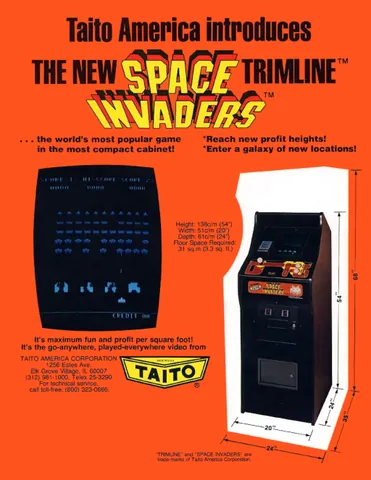
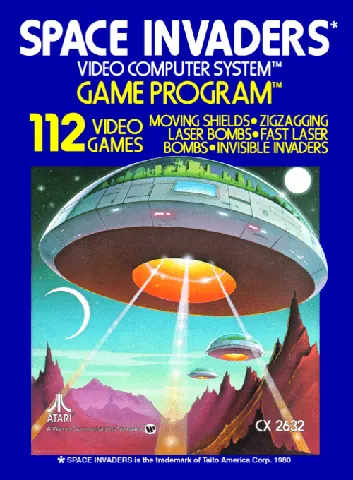
Taito's 1978 arcade original ran on a black-and-white monitor, with color coming only from strips of colored cellophane taped over the screen, plus the iconic four-note bass beat that sped up as the invasion closed in. The home port for Atari 2600 in 1980 had to simplify everything into blockier, fully colored sprites with less detail, yet it became the first officially licensed arcade conversion on a console and famously sold hardware — many bought a 2600 just to play it. In return it offered dozens of game variations (moving shields, invisible invaders, two-player mode) the arcade never had, so today it's worth comparing the stripped-down but addictive home version with the atmosphere of the original cabinet.