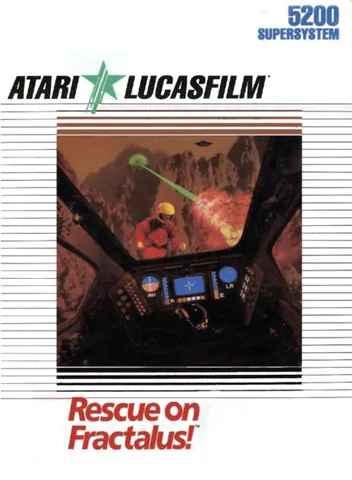
Rescue on Fractalus!
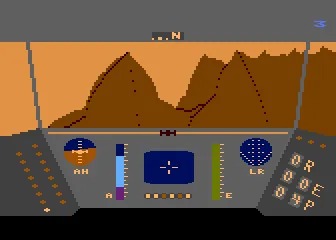
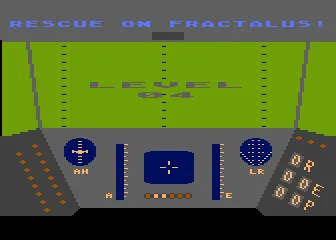
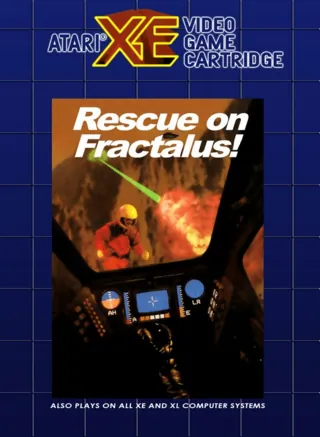
Rescue on Fractalus! transports the player to the surface of an inhospitable planet, where the task is to rescue survivors from crashed Federation fighters. The player sits in the cockpit of a Valkyrie fighter and views a mountainous landscape generated by a fractal algorithm through the windshield - in 1984, this was a technical marvel, making the mountains look like real three-dimensional terrain rather than a flat backdrop. The task is to land safely near a signal, open the cockpit door, and let the pilot board, while staying alert to whether an enemy Jaggi is hiding behind the pilot's mask, ready to destroy the ship from within once let aboard.
On the Atari 5200, developers at Lucasfilm Games had to adapt the game to more modest hardware than the original for Atari 8-bit computers, but the essential principle of real-time fractal terrain rendering was preserved. Joystick control allows tilting the fighter, controlling flight altitude, and shooting at enemy aircraft circling around the mountains trying to shoot the player down before the rescue mission can be completed. The atmosphere is rounded out by a spare, tense soundtrack and a sense of loneliness amid an alien, inhospitable landscape where every landing can end in tragedy. The game's very structure was also thoroughly novel - no points for downed enemies, no exaggerated action, just patient maneuvering among peaks and the tension of not knowing whether a real survivor or a trap lurks behind the windshield.
The game was seen at the time as one of the most impressive technical achievements on home platforms, and it foreshadowed Lucasfilm Games' later interest in simulations and flight action, which the studio continued to develop in subsequent years. It was precisely this combination of slow, deliberate pacing with an almost meditative feeling of flying over an unknown planet that made it a title fundamentally different from most of its contemporary arcade competition on the Atari 5200. Today, Rescue on Fractalus! comes across more as a historical curiosity - the pace is slow and the graphics blocky - but as evidence of how far courage and ingenuity could go on hardware with such limited power, it still deserves respect even decades later.
Why play it: As evidence of a bold technical experiment on limited hardware, though today's players will likely find it more interesting as a slow, blocky historical curiosity than as a fully satisfying playable experience.
Game 22 of 41 for Atari 5200