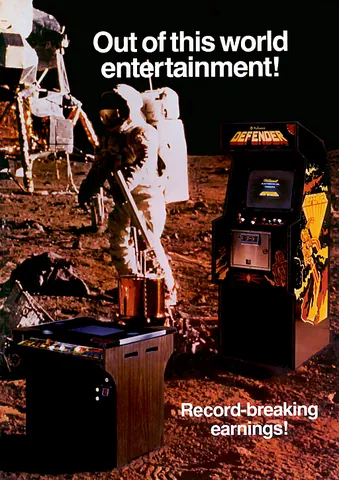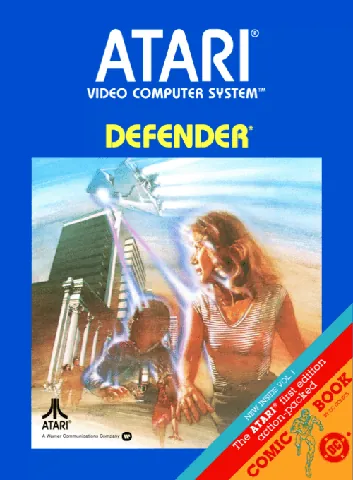
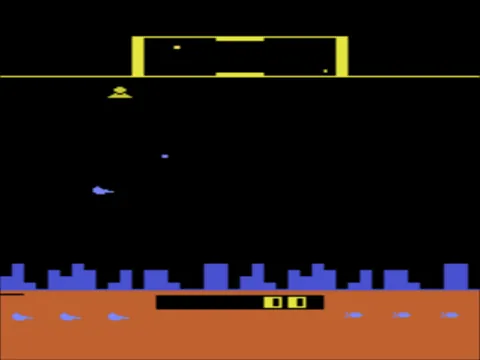
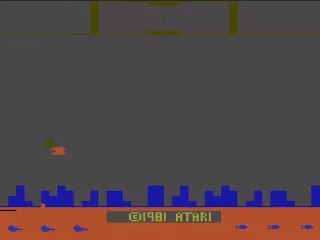
Defender was released for the Atari 2600 in 1982 as a port of the famous arcade machine by Williams Electronics, in which the player pilots a spaceship defending human colonists on a planet's surface from an alien invasion. The game takes place on a horizontally scrolling flat map, and the player can move in both directions, while a radar at the top of the screen tracks the position of enemies and abducted colonists scattered across the length of the map, allowing the player to plan a route ahead.
The key mechanic is rescuing colonists whom enemies abduct upward from the planet's surface - if the player fails to rescue an abducted colonist in time, it transforms into a more dangerous and aggressive type of enemy that then attacks the player's ship itself and is harder to destroy. This pressure for quick decision-making sets Defender apart from slower shooters of the same era and forces the player to constantly choose between attacking and rescuing. The Atari 2600 port had to contend with the console's technical limitations, resulting in simplified graphics, fewer objects displayed simultaneously, and a partial slowdown of the action compared to the fast arcade original, yet it managed to preserve the basic principle of defense and navigation in an open scrolling space, as well as the use of radar as a key informational element.
Defender was one of the most successful and influential arcade titles of the early 1980s, and its concept of scrolling defense with radar and civilian rescue inspired numerous later shooters across multiple platforms. The home port for the Atari 2600 did not match the quality of the arcade machine and was criticized for its technical compromises, but it was still a sought-after title for fans who wanted to play their favorite arcade game at home without having to visit arcades and feed coins into the machine for every new attempt.
Why play it: For fans of the beloved arcade machine, this offers, despite the technical compromises, a convenient way to enjoy scrolling defense with radar and civilian rescue at home without feeding coins into an arcade machine.
Game 41 of 69 for Atari 2600
The same title elsewhere (2)
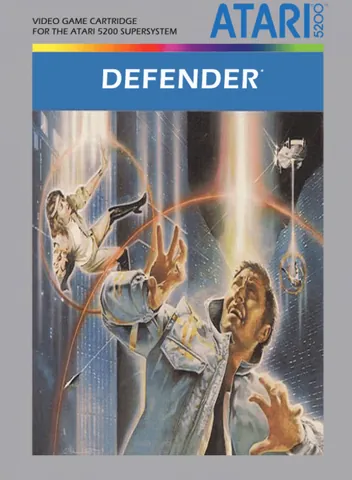
The Williams arcade original ran on its own vector-based graphics hardware, giving smooth, fast movement and a full set of controls — thrust, reverse, fire, smart bombs and hyperspace — that rewarded precise hand-eye coordination. The Atari 5200 port tried to preserve that control scheme but relied on the console's analog joystick, notorious for imprecision and wear, which made fine ship handling noticeably harder in a game built around exactly that. Graphics and sound had to be scaled down to home 8-bit hardware, so scrolling feels less smooth and the audio thinner than on the arcade board. If you want Defender at its best, the arcade version is the one to pick.