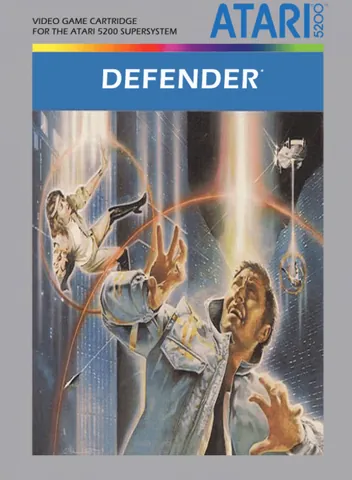
Defender
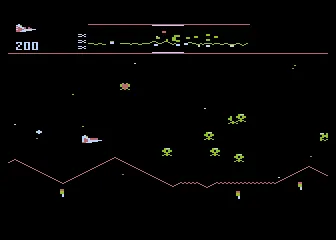
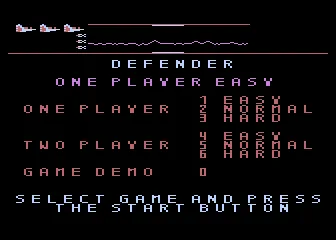
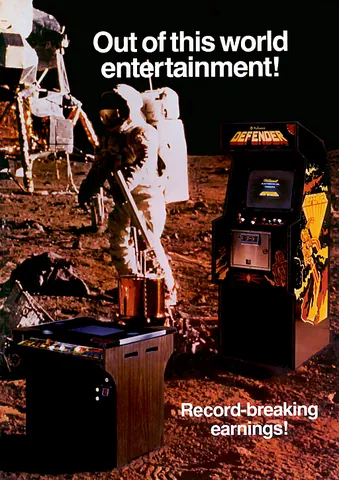
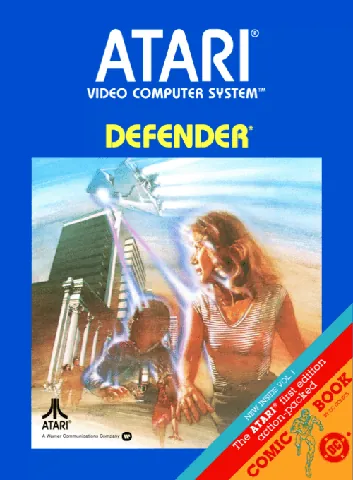
A horizontally stretching planet across which defenseless humans move, and you in a fast fighter whose task is to protect them from abductors from space — Defender was famous in the early eighties for its brutal difficulty and complex controls, which made it one of the most demanding but also most respected arcade machines of its time. The version for the Atari 5200 brought this merciless experience home.
In gameplay terms, Defender is a two-way scrolling shooter in which you control a ship capable of flying both left and right over the continuously flowing surface of the planet. Your task is not only to shoot enemies, but also to catch falling little humans that the aliens are trying to abduct and turn into dangerous mutants. There is also a radar that shows what is happening off-screen. This combination of multiple tasks and directions made the game famous for a difficulty that separated the greenhorns from the masters.
In development terms, Defender came from the company Williams Electronics, and its authorship is tied to a name that belongs among the legends of the field. The game became one of the commercially most successful arcade machines of the golden era, and its complexity was almost daring for its time — instead of simplicity, it bet on depth and multi-layeredness.
The cultural significance of Defender lies in the fact that it expanded the boundaries of what a shooter could be. It introduced the concept of protecting civilians, two-way movement, and radar, and it inspired a number of successors. For many players it remains synonymous with an uncompromising arcade challenge that only the most persistent will sweeten for themselves today.
The Atari 5200, as the successor to the Atari 2600, offered more powerful hardware suitable for porting demanding arcade games. A home version of such a complex game was an ambitious undertaking. Today Defender is a great window into the time when arcades competed over who would offer the deepest and most demanding experience.
Why play: Defender is a legendarily hard but brilliantly designed arcade game with civilian protection and two-way flight — a challenge for players who love it when a game gives nothing away for free.
Game 8 of 41 for Atari 5200
The same title elsewhere (2)
The Williams arcade original ran on its own vector-based graphics hardware, giving smooth, fast movement and a full set of controls — thrust, reverse, fire, smart bombs and hyperspace — that rewarded precise hand-eye coordination. The Atari 5200 port tried to preserve that control scheme but relied on the console's analog joystick, notorious for imprecision and wear, which made fine ship handling noticeably harder in a game built around exactly that. Graphics and sound had to be scaled down to home 8-bit hardware, so scrolling feels less smooth and the audio thinner than on the arcade board. If you want Defender at its best, the arcade version is the one to pick.