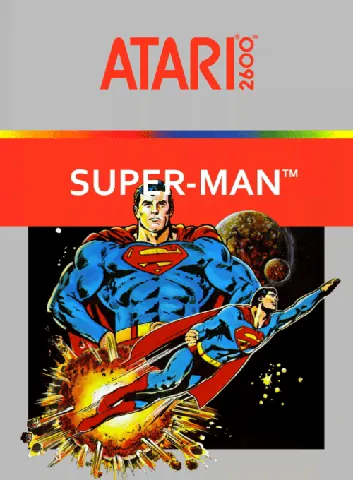
Superman
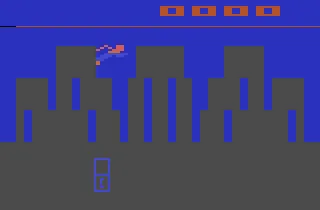
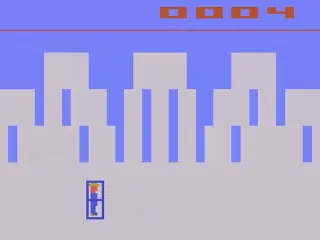
Superman was released by Atari in 1979 as one of the first action-adventures with an open play space, in which the player, as the Man of Steel, searches a map divided into several interconnected screens of the metropolis, trying to collect scattered pieces of Lex Luthor's prison, neutralize villains, and rescue Lois Lane from various dangers, including a crashed helicopter and a burning bridge. The player moves between screens, collects items into a limited inventory, and must decide independently in what order to complete the individual tasks, since the game prescribes no fixed path and leaves the player free to explore the map at their own pace.
The game introduced mechanics unusual for its time, such as time-limited gameplay in which Superman gradually loses strength due to kryptonite scattered across the map, or the ability to transform back into Clark Kent and pass through a phone booth to escape enemies or move more quickly elsewhere in the guise of an ordinary journalist. Both graphics and sound on the Atari 2600 remain necessarily sparse and simple, but the large interconnected map and nonlinear progression were a fairly unique design achievement in the late 1970s that was ahead of its time and foreshadowed the later action-adventure genre.
Superman was among the games that helped define early open-world action-adventures, and its influence can be seen in later titles of the same genre on the Atari 2600, including the more famous Adventure. Today it is appreciated more by video game historians as evidence of experimentation with nonlinear design than as a game that holds up well against later entries in the genre, yet it remains an important milestone in the history of game development and licensed comic-book adaptations for home consoles, even though it may seem less accessible to today's players than later titles of the same genre.
Why play it: For video game historians and fans of early open-world design, this is an important milestone, though the average player today will likely find the controls and nonlinear structure rather clunky.
Game 43 of 69 for Atari 2600