Berzerk
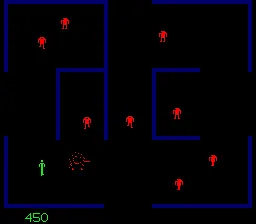
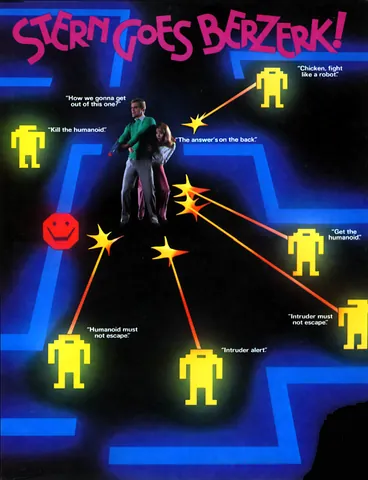
Berzerk is among the pioneering titles of the maze shooter genre and is notable for several reasons. The player moves through a series of rooms full of robots that must be neutralized before they get him, while touching an electrified wall means instant death, just like being hit by enemy fire. After clearing a room, another randomly generated one awaits beyond the door, which in 1980 pushed the game toward an endless, procedurally shifting challenge. The robots also fire in straight lines along the room's axes, so the player must constantly recalculate safe corridors between their fire and the electrified walls.
Berzerk earned special attention for its synthesized voice, which let the robots utter short lines during play – one of the very first uses of digitized speech in an arcade game at all. This technical novelty seemed almost a curiosity at the time and helped the cabinet quickly earn a reputation as an inventive and unmistakable experience. Besides the robots, the player also faces the legendary Evil Otto, a smiling bouncing smiley face that appears if the player lingers too long in a room, and killing him is practically impossible – his only function is to chase the player quickly out of the room.
Berzerk also made history in a sad way – deaths of players caused by overexertion while playing were recorded in connection with the game, which later contributed to discussions about the health effects of arcade games. In terms of gameplay, however, Berzerk remains valued as one of the founding titles of the genre, one that showed randomly generated environments and voice effects could substantially enrich a simple shooter concept.
Why play it: a historically pivotal maze shooter with voice effects and the unforgettable Evil Otto.
Game 91 of 258 for Arcade
The same title elsewhere (3)
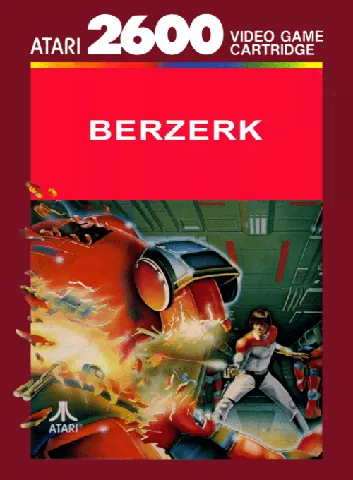
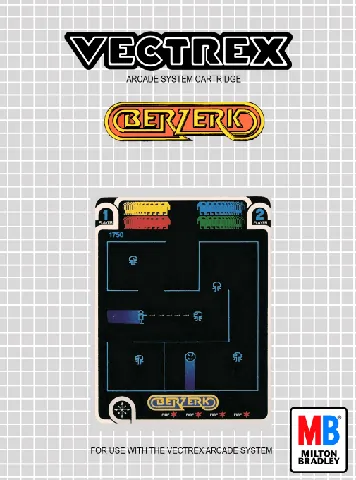
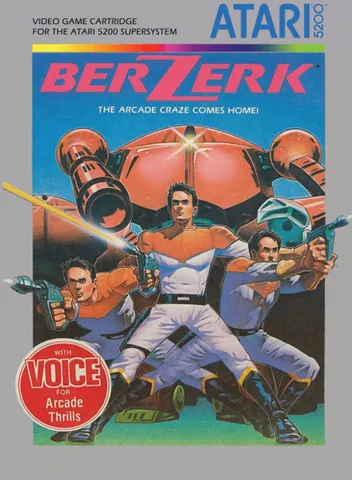
Stern's arcade original was famous for its digitized robot voices and vector graphics, and that's exactly what sets the home conversions apart. The GCE Vectrex version ran on its own vector display, so it kept the sharp, glowing lines close to the arcade look, albeit without the voice work. The Atari 2600 version had to replace the vector graphics with cruder raster drawing, fewer details, and simplified robots, and the sound was also noticeably more limited. Anyone wanting the experience closest to the arcade cabinet should pick the Vectrex; the Atari 2600 offers a simplified but still playable alternative.